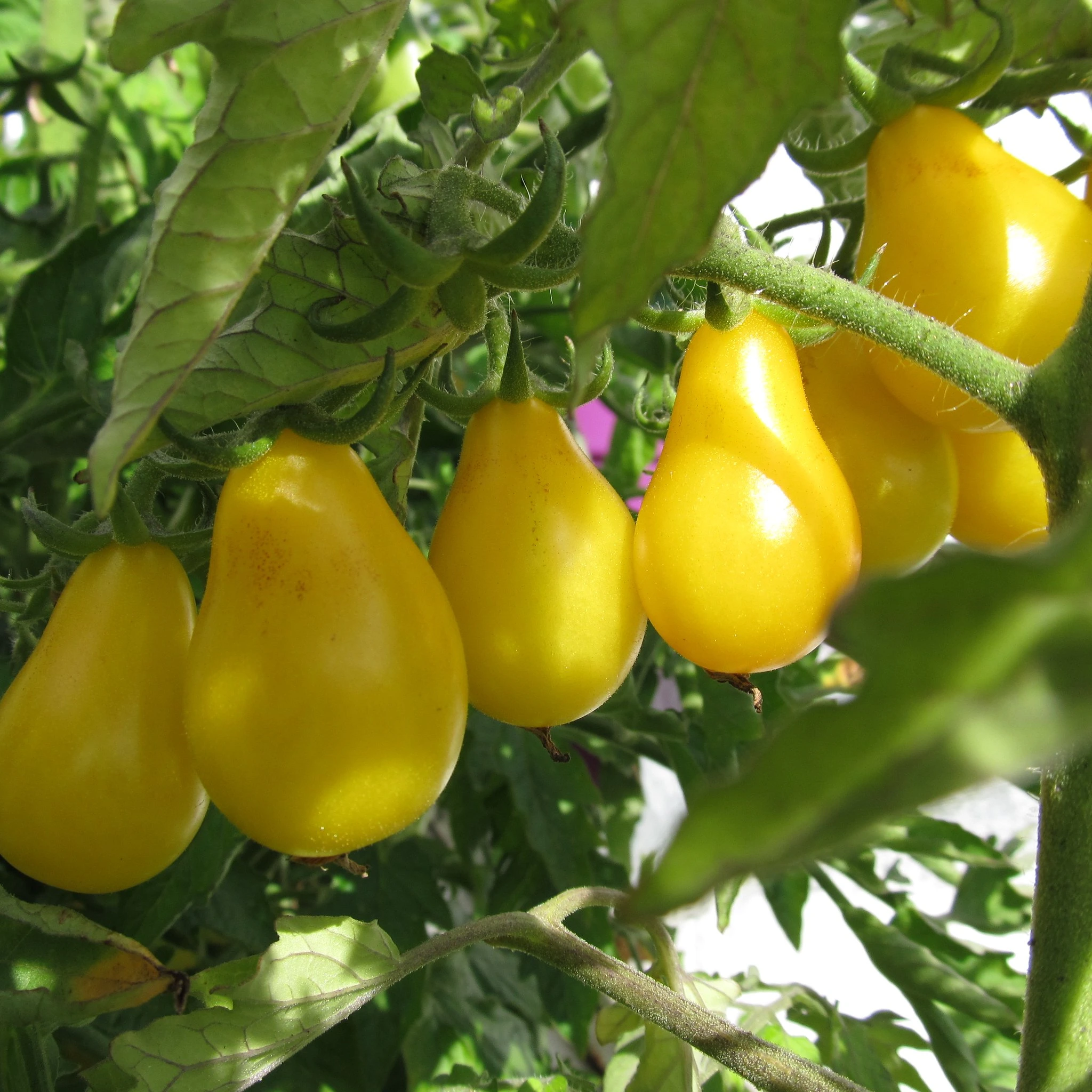
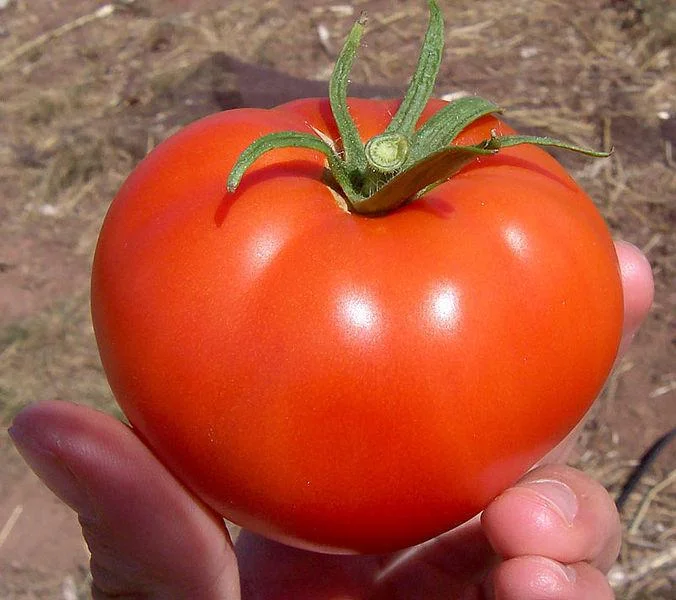
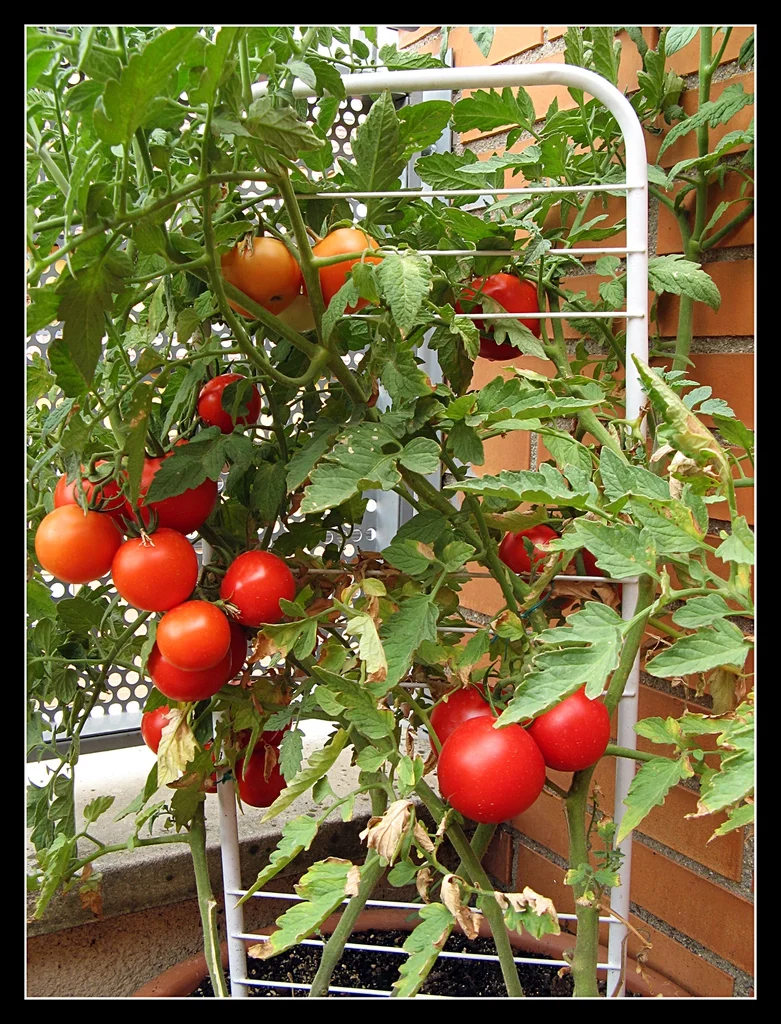
Yellow Pear is a distinctive pear-shaped, bright yellow heirloom cherry tomato dating to at least the 1800s. Its flavor is mild, sweet, and low in acid — less sweet than modern hybrids, but the plant is a prolific producer and excellent for color contrast in salads. It is open-pollinated, with seeds viable for saving. Tomato plants are toxic to dogs, cats and horses if eaten (solanine); the ripe fruit is not (ASPCA). Key facts for Yellow Pear Tomatoes: 70–80 days to maturity from transplant, 8+ hours of sun, 24–36" spacing. Not recommended for containers. Requires cage for best results.
Updated October 8, 2026·Backed by 4 cited sources
Overview
At a Glance
The essentials first: timing, light, spacing, seed-starting, container fit, and overall size.
Days to maturity
70–80 days
from transplant
Sun
8+ hours
Best: full sun, 8-10 hours
Spacing
24–36"
between plants
In practice
24" pruned on stakes; 36" caged.
Seed start
6–8 weeks
before transplant
Container
No
Needs 10+ gal if attempted
Height
6–10 ft
at maturity
Planting window
Zone Planting Guide
Switch zones to see whether this plant is a strong fit, what frost timing looks like, and any extra notes worth planning around.
This card updates instantly with viability, frost timing, and any planting notes for your selected zone.
Care
Growing Guide
Everything in one place: seed starting, transplant timing, watering, soil, and structural support.
Every answer is assembled from this cultivar's own record, so the figures match the rest of the page.
How many days to maturity for Yellow Pear Tomatoes?
Yellow Pear takes 70–80 days to reach maturity from transplant.
How far apart should you plant Yellow Pear Tomatoes?
Space Yellow Pear 24–36 inches apart, with 36–48 inches between rows.
How much sun do Yellow Pear Tomatoes need?
Yellow Pear needs at least 8 hours of direct sun a day.
How much water do Yellow Pear Tomatoes need?
Yellow Pear needs 1–2 inches of water a week, counting rainfall.
What soil pH do Yellow Pear Tomatoes need?
Yellow Pear grows best in soil with a pH of 6–6.8, ideally around 6.5.
How tall do Yellow Pear Tomatoes get?
Yellow Pear reaches 6–10 feet at maturity, and needs caging to stay upright.
How do you start Yellow Pear Tomatoes from seed?
Start seed indoors 6–8 weeks before your transplant date. Move plants outside once the soil reaches 60°F, about 14 days after your last frost.
What temperature do Yellow Pear Tomatoes seeds need to germinate?
Yellow Pear seeds germinate best at 80°F, within a workable range of 65–85°F, and take 5–10 days to emerge.
Can you grow Yellow Pear Tomatoes in containers?
Yellow Pear is not recommended for container growing. It would need at least 10 gallons if attempted, and compact varieties suit pots far better.
When is Yellow Pear in season?
Yellow Pear is a warm-season crop, in season from mid-summer through fall in most regions. Plants reach harvest 70–80 days after transplanting and keep producing until the first fall frost.
Resilience
Plant Health
Stress tolerance, resistance notes, and the most common problems to watch for as plants mature.
Curly top virusBeet curly top virus (BCTV); Geminiviridae, Curtovirus
Severe
Disease
May–SepPeak window months: May, Jun, Jul, Aug, Sep.
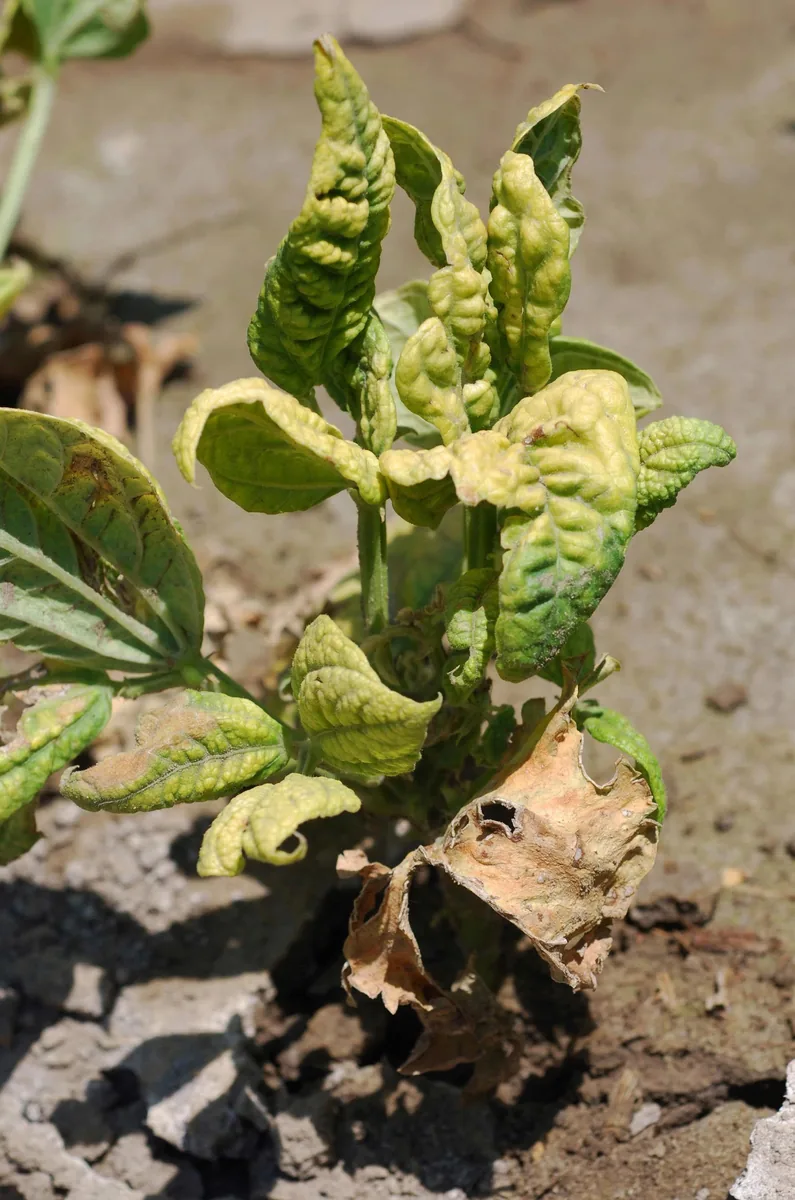
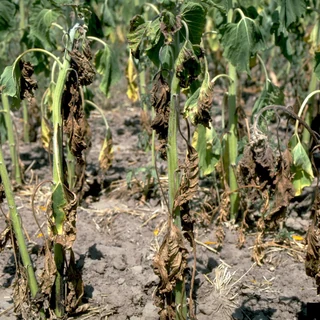
A virus spread by the beet leafhopper (Circulifer tenellus), mainly a problem in the western US — California, Arizona, Colorado, Idaho, New Mexico, Utah, and Washington. It has a broad host range, infecting beets, tomatoes, peppers, beans, and cucurbits. Infected plants develop curled, thickened leaves with purple-tinged veins on the undersides, stunted growth, and fruit that ripens prematurely. The leafhopper transmits the virus while migrating: it lands and briefly probes plants, and a single feeding of just a few seconds is enough to infect.
Where it lives: Western US, from the Great Plains to the Pacific
Triggers: Driven by leafhopper migration, not weather directly. The bugs overwinter in foothill weeds and head for gardens in late spring once the wild vegetation dries up. Hot, dry years push more of them into populated areas. Symptoms show up 7-14 days after a single leafhopper visit — and a single bite is all it takes.
What it looks like: Plants stop growing and stay stunted, turn yellow to bronze, and the leaves take on a purple tinge. Plants go stiff and soon die. Green fruit turns red early, whatever its age.
Disease or overwatering? A stunted, stiff, yellow-bronze plant with purple-tinged leaves and green fruit turning red early points to curly top. Watering stress causes softer, general wilting and yellowing without stiffness or purple tones, and recovers once watering is fixed.
Will it recover? Infected plants don't recover and soon die. Pull them. Next time, there are no resistant tomato varieties, so plant densely, since leafhoppers seem to avoid thick stands, and avoid planting next to bare ground where leafhoppers feed.
Risk fades when: Migration peaks in late spring; once the main wave passes, transmission risk drops sharply. The virus doesn't hide in soil or plant debris between seasons, so risk resets each year.
Fusarium wiltFusarium oxysporum f. sp. lycopersici
Severe
Disease
May–SepPeak window months: May, Jun, Jul, Aug, Sep.
A soil-borne fungus that gets into tomato roots and clogs the vascular system, causing one-sided yellowing and wilt that eventually takes down the whole plant. Three races exist (1, 2, 3), and resistant tomato varieties are bred for each. The fungus can survive in soil for up to 10 years without a single tomato planted. It loves warm, slightly acidic soil around 82°F. People often mistake it for Verticillium wilt — the giveaway is that fusarium hits one side of the plant first.
Triggers: Optimal soil temperature is 82°F (28°C). Damage is worse in acidic soils (pH 5.0-5.5). Symptoms usually appear mid- to late season once soils warm up. The pathogen enters through root wounds — cultivation injury or nematode feeding both open the door.
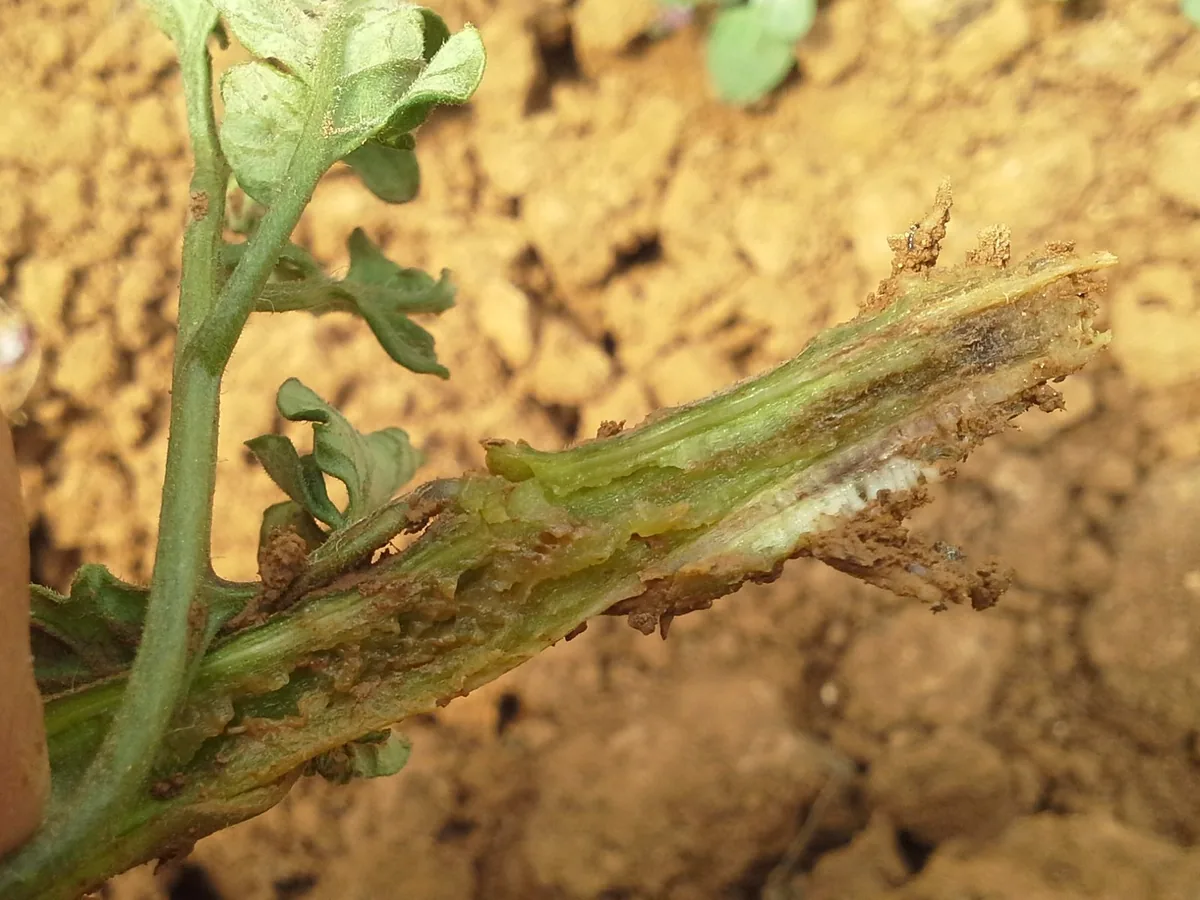
What it looks like: Single branches and their leaves turn yellow and wilt, and often only one branch or one side of the plant is hit at first, like a yellow flag. Slice the lower stem and a dark brown streak runs far up the inside. Symptoms usually show as the fruit is sizing up, and the plant usually dies.
Disease or overwatering? One-sided yellowing with dark brown streaks far up the inside of the stem points to Fusarium. Verticillium wilt looks so similar that only a lab can confirm which one it is. Overwatering yellows the plant evenly and leaves the inside of the stem clean.
Will it recover? Infected plants usually die, so remove them. Next time, grow varieties resistant to Fusarium races 1 and 2 (a few resist all three), clean soil off tools, prevent root-knot nematodes because they break down that resistance, and keep tomatoes out of that bed for several years.
Risk fades when: Activity slows when soils cool below 70°F. The seasonal pressure fades, but the pathogen itself persists in the soil for up to 10 years.
May–SepPeak window months: May, Jun, Jul, Aug, Sep.
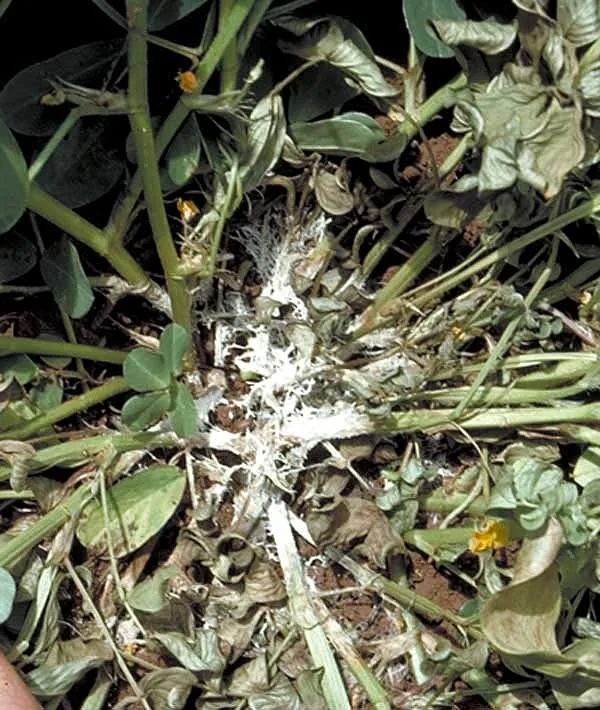
A soil-borne fungus (Sclerotium rolfsii) that attacks plant stems right at the soil line during hot weather. It hits over 500 different plant species. Two telltale signs to look for: white fan-shaped fungal growth on the lower stem, mulch, and soil surface, and tan-brown spherical sclerotia (they look like mustard seeds) on infected tissue. Most active during sustained heat with humid conditions.
Triggers: Optimal at 86°F (30°C) soil and air temperature with humid conditions. Inactive below 70°F. Most damaging during sustained mid- to late-summer heat waves. It extends further north in warmer-than-normal seasons.
What it looks like: A rotted patch forms on the stem at or just above the soil line and quickly circles it, so the whole plant wilts suddenly and for good. White threads of fungus mat the stem base and nearby soil, and within a few days tiny tan to brown round balls, about the size of mustard seed, appear on the mat.
Disease or overwatering? White fungus threads with small tan balls at the soil line are the giveaway. Overwatering causes slow yellowing and wilting from the base, not a sudden collapse with a white mat.
Will it recover? The wilt is permanent, so the plant can't be saved. Remove it with its root ball and the soil around it. Next time, rotate to corn or other grains for at least 2 years, bury old plant debris deeply and keep the soil surface around stems dry.
Risk fades when: Sustained cooler weather — highs below 80°F and overnight lows below 70°F for 5+ days — reduces fungal activity. The sclerotia (resting bodies) persist in soil for years, so resolution is seasonal, not curative.
Athelia rolfsii mycelium on peanut (Arachis hypogaea) (resized, converted to WebP) — Photo:
Gerlach W / EcoPort
·
CC BY-SA 3.0
Blossom dropTomato flowers are temperature-sensitive.
High
Physiological
Apr, May, Jul, AugPeak window months: Apr, May, Jul, Aug.
Tomato flowers are temperature-sensitive. When day temperatures climb above 85°F and night temperatures stay above 72°F for several days, the pollen becomes sticky and nonviable — flowers dry up and drop before fruit can set. Cool nights below 55°F do the same thing from the opposite direction. Most cultivars recover once temperatures normalize, but the heat wave eats a round of harvest from each cluster affected. Heat-set hybrid varieties tolerate the high end better than heirlooms.
Triggers: Day >85°F + night >72°F for 3+ consecutive days triggers pollen abortion. Night <55°F (more common early/late season) triggers the cold-flush version. Humidity above 80% prevents pollen release even at normal temperatures.
On Yellow Pear: Temperature extremes
Prevention: Shade cloth in extreme heat
Risk fades once daytime highs drop below 90°F and nighttime lows stay between 55-72°F for several days. Most cultivars resume fruit set within a week of recovery; the lost flower flush isn't recovered but new growth is.
Blossom end rotBlossom-end rot looks like a disease but isn't — it's a calcium transport failure inside the plant.
High
Physiological
Jun–AugPeak window months: Jun, Jul, Aug.
Blossom-end rot looks like a disease but isn't — it's a calcium transport failure inside the plant. Calcium moves with water, so any disruption to water flow (drying out between watering, soaking after dry weather, heavy nitrogen feeding pulling calcium toward leaves instead of fruit) leaves expanding fruit cells starved for calcium. The cell walls collapse, creating the dark leathery patch on the blossom end. Most often hits the first 2-4 fruits in each cluster — that's when the plant is growing fastest. Once a fruit shows BER it can't heal; remove it so the plant can put energy into healthy ones. Subsequent fruits often turn out fine once watering is steadied. Large plum and paste cultivars are most susceptible; cherry tomatoes are rarely affected.
Triggers: Calcium moves with water. Drought followed by heavy watering, shallow watering, or excess nitrogen pulling calcium to leaves all starve the expanding fruit. Low soil pH (<6.0) also locks up calcium. First 2-4 fruits per cluster most often affected because plant is growing fastest at first fruit set.
Risk fades as the plant settles into steady moisture and reaches mid-season fruit production. The first 2-4 fruits per cluster are most often affected; later fruits typically come out fine. Once a fruit shows BER it cannot recover — remove it so the plant directs energy to healthy fruit.
Colorado potato beetle (yes, yellow pear gets these too)Leptinotarsa decemlineata
High
Pest
May–AugPeak window months: May, Jun, Jul, Aug.
The Colorado potato beetle is the most serious insect pest of potatoes, and it also feeds on eggplant, tomato, tomatillo and pepper. The striped adults and the humpbacked red larvae chew the leaves, often feeding in groups, and can strip plants badly enough to cut the harvest or kill the plant. Adults spend the winter in the soil and become active in spring at about the time potatoes come up. Most areas get two generations a year. The beetle is resistant to over 50 insecticide ingredients, so hand-picking and other non-spray steps matter most.
Where it lives: Most of the US except Alaska, California, Hawaii and Nevada
Triggers: Adults spend the winter 5 to 10 inches deep in the soil of gardens, fields and field edges. They become active in spring at about the time potatoes come up, feed briefly, then lay clusters of yellow-orange eggs under the leaves. Eggs hatch in about a week. Larvae finish growing in about 10 days when temperatures average in the mid-80s F, but take over a month near 60 F. Full-grown larvae drop and pupate in the soil. Egg to adult can take as little as 21 days. Beetles cannot move very far until temperatures reach 70 F. Two generations a year in Minnesota, Pennsylvania and Maryland; two and sometimes a partial third in Kentucky.
Risk fades when: In Maryland adults come out of the soil in late April to early May. In central Pennsylvania overwintered adults come out in early May and lay eggs from early to late June, earlier in warmer parts of the state. Adults that emerge in late July and early August usually start a second generation; those that emerge after mid-August feed for a few days and then dig in for the winter. By midsummer eggs, larvae and adults can all be present at once (UMN Extension; Penn State Extension; University of Maryland Extension).
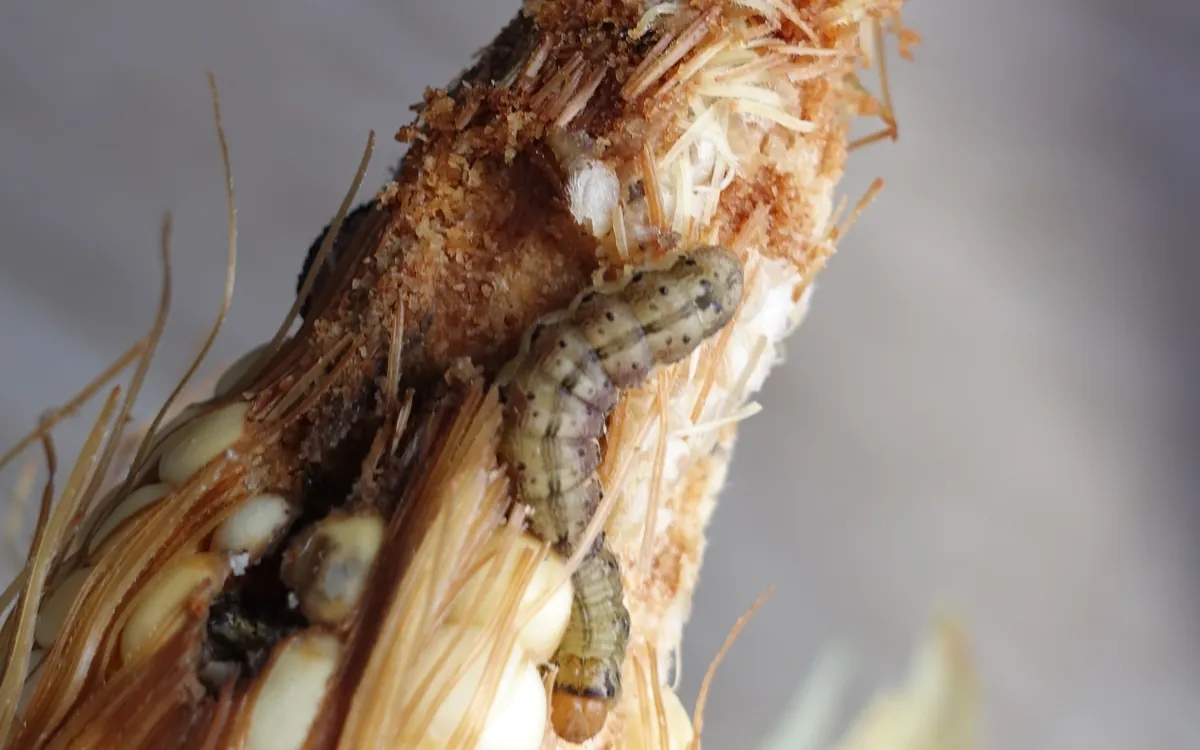
Corn earworm is the same species as tomato fruitworm and cotton bollworm — a polyphagous caterpillar that bores into ears of corn through fresh silks, into tomato and pepper fruit, into lettuce heads, and into bean and pea pods. In sweet corn, losses can reach 50%. The species migrates north annually from southern overwintering grounds; in much of the northern US, it does not survive the winter when temperatures drop below 30°F.
Where it lives: Across the US except Alaska; moths fly north from the South each summer
Triggers: Overwinters as pupa in top 2-4 inches of soil where winter temps permit. North of I-70 (Illinois IPM): does not reliably overwinter — populations arrive via migration mid-July through September. Females prefer fresh corn silks for egg-laying; older silks rejected.
Risk fades when: In the North (above roughly 40 degrees latitude) the insect does not overwinter, so populations arrive only by summer migration and are wiped out by fall frost, resetting each year; in the South it overwinters as a soil pupa and pressure lasts longer (UMN VegEdge, Wisconsin Hort, Cornell IPM).
Corn earworm (Helicoverpa zea) larvae in a damaged ear of corn — Photo:
Scot Nelson
·
CC0 1.0
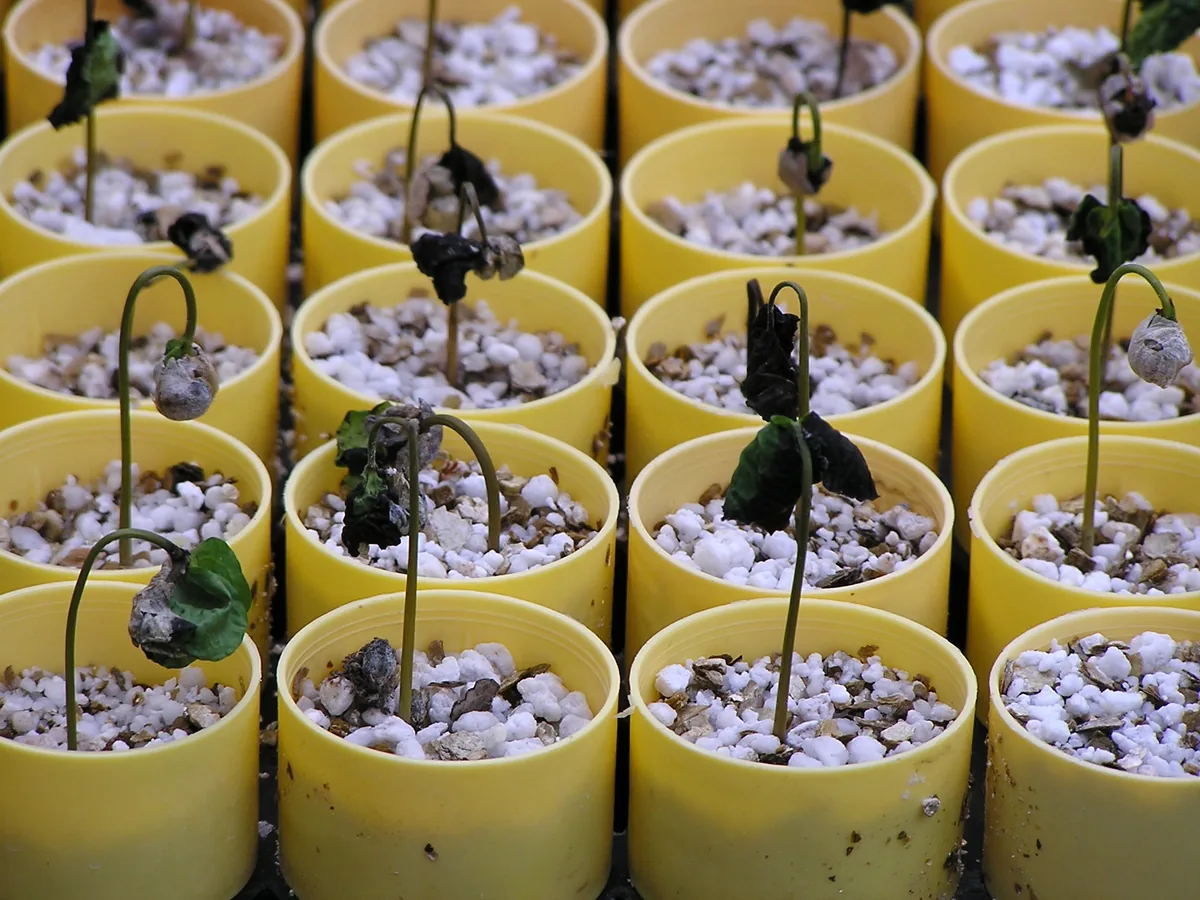
A seedling killer caused by several different fungi working together. It hits vegetables, flowers, herbs, microgreens, and cover-crop seedlings the same way — seeds rot before they emerge, or young seedlings collapse right at the soil line. Wet seed-starting mix and poor airflow in seedling trays are the classic conditions.
Triggers: Wet soil or starting mix, poor drainage, seedlings packed too tightly, contaminated trays or media, and stagnant air all favor damping-off.
Risk fades when: Drying the soil surface and improving airflow slows new spread. Collapsed seedlings don't recover, but the rest of the tray can be saved.
Damping off of coffee seedlings caused by Fusarium sp. — Photo:
Scot Nelson
·
CC0 1.0
Late blightPhytophthora infestans
High
Disease
May–AugPeak window months: May, Jun, Jul, Aug.
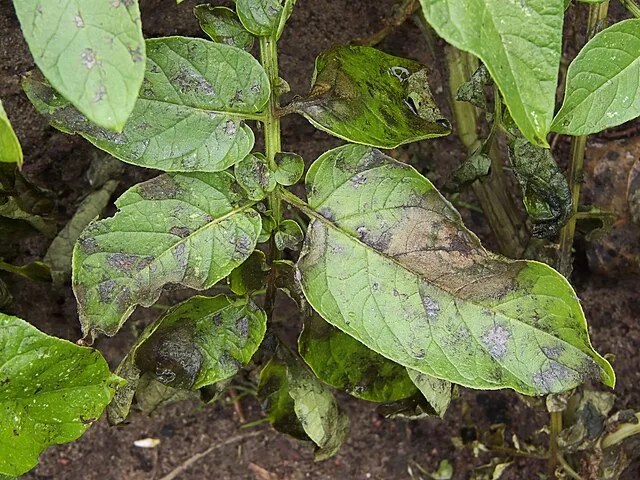
The most destructive disease of tomatoes and potatoes — it can kill mature plants within days once it gets going. Spreads explosively in cool, wet weather, which is why outbreaks tend to hit suddenly after a stretch of rainy nights.
Triggers: Infection takes only about 10 hours when humidity stays above 90% and the mean temperature is 60-78°F. As a daily proxy: a wet day with the mean temp in that range puts you in the danger zone.
What it looks like: Large dark brown blotches on leaves with a green-gray edge, spreading across the leaf without stopping at the veins. In damp weather a thin white powdery growth shows on leaves, stems and fruit. Stem patches are firm and dark brown; fruit gets firm dark brown spots that can cover much of the fruit.
Disease or overwatering? Big dark blotches that cross the leaf veins, with white growth in humid weather, point to late blight. Early blight spots are smaller, start on the oldest leaves near the ground and show target rings. Wilting in wet soil with plain yellowing and no blotches points to too much water.
Will it recover? Blotched leaves, stems and fruit don't recover, and the disease spreads fast to nearby plants. Pull and bag infected plants rather than trying to save them. Next time, grow resistant varieties, water at the base in the morning, space plants for airflow and clear all plants at season end.
Risk fades when: Spores survive roughly 5 hours at 80% humidity. Three consecutive dry days with highs above 75°F will likely break immediate spore viability, though damaged tissue stays damaged.
Phytophthora infestans on potato leaf (Dore variety) (resized, converted to WebP) — Photo:
Rasbak
·
CC BY-SA 3.0
Poor fruit setPoor fruit set means flowers appear normal but never produce fruit — they yellow, dry up, and drop.
High
Physiological
Jul–AugPeak window months: Jul, Aug.
Poor fruit set means flowers appear normal but never produce fruit — they yellow, dry up, and drop. Most often this is heat-related pollen failure: day temperatures above 90°F, night temperatures above 75°F, or relative humidity above 80% all prevent pollen from being viable or released properly. Bean, tomato, pepper, squash, and cucurbit crops all experience it. For insect-pollinated crops (squash, cucumber, melon, watermelon), insufficient bee activity during flowering compounds the problem. Some crops recover with cooler weather and produce normally in late summer; others permanently lose a flush. Plant heat-tolerant varieties for hot-summer locations and time spring sowings to flower before the worst heat.
Triggers: Per UDel/UMD/UIllinois Extension: day temps >90°F + night temps >75°F + RH >80% during flowering all reduce pollen viability. Tomato extreme threshold: day >95°F / night >80°F causes complete pollination failure. Bean threshold: night >68°F (snap) / >70°F (lima) reduces set. Cucurbits also need adequate bee activity — heat reduces both pollen viability AND bee foraging.
Risk fades when: Most warm-season crops resume fruit set within 1-2 weeks of cooler weather. Bean and pepper plants typically catch up on harvest in late summer when temperatures moderate. Lost flush isn't recovered but later flowering is normal.
Root rotPythium spp. / Phytophthora capsici
High
Disease
May–AugPeak window months: May, Jun, Jul, Aug.
A water mold (not a true fungus) that attacks roots and crowns in waterlogged soil. It's most dangerous in heavy, poorly drained soil after extended rain — basically any time water sits around plant roots for days.
Triggers: Pythium infects from 50-95°F as long as the soil stays saturated. Phytophthora capsici is most active at 75-85°F. What matters most is how long the soil stays waterlogged, not just whether it rained.
What it looks like: Plants grow slowly and may wilt or die in hot weather. Dig one up: the roots, large and small, have brown rotted patches, the inside of the root above them turns yellow or brown, and in bad cases most roots have rotted off. Phytophthora capsici can also make greasy purple-brown patches on the stem.
Disease or overwatering? Brown rotted patches on the roots point to root rot; a waterlogged plant without rot still has firm roots. The two often go together, because this disease does the most damage in poorly drained, packed or overwatered soil.
Will it recover? Rotted roots don't recover, and badly infected plants often wilt or die once it turns hot. Let the soil dry out between waterings. Next time, plant where water drains, never let the bed flood and avoid big swings between soggy and dry.
Risk fades when soil returns to field capacity (normal drained moisture). How long that takes depends on your soil — sand drains in hours, clay can take days.
Year-roundPeak window months: Jan, Feb, Mar, Apr, May, Jun, Jul, Aug, Sep, Oct, Nov, Dec.
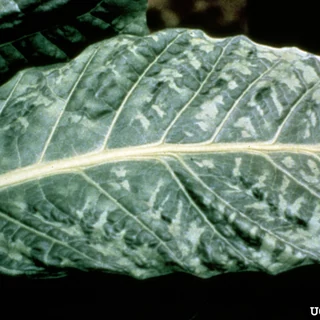
An exceptionally stable plant virus that spreads mostly by mechanical contact — handling plants, garden tools, smoking near plants, even infected seed. Causes mottled light and dark green patches on leaves, distorted growth, and reduced fruit yield. The virus survives for years on dried plant material and resists most disinfectants. There is no cure once a plant is infected. TMV affects tomato, pepper, eggplant, and many ornamentals. The resistance gene (Tm-1, often coded T on seed packets) is widely available in modern tomato hybrids. Smokers should wash hands and avoid handling tomatoes if their tobacco may carry the virus.
Triggers: Spread is mechanical (hands, tools, contaminated debris, infected seed), not weather-driven. SoilStack alerts when active-season conditions warrant scouting and tool sanitation.
What it looks like: A mild light and dark green mottle on the leaves, with some leaves misshapen, sometimes fern-like or, in cool weather, narrowed to shoestrings. Fruit can show dead brown patterns.
Disease or overwatering? A mottled light and dark green pattern with misshapen leaves points to tobacco mosaic virus or its close relative tomato mosaic virus; wilt diseases and overwatering cause even yellowing with no mottle. Tobacco mosaic and tomato mosaic look the same in the garden, and only a lab test tells them apart.
Will it recover? There is no treatment that clears the virus from a plant. It spreads on hands and tools, not by insects, so handle plants as little as possible; the source calls for extreme sanitation. Next time, use treated seed, a resistant variety and strict hygiene.
Year-roundPeak window months: Jan, Feb, Mar, Apr, May, Jun, Jul, Aug, Sep, Oct, Nov, Dec.
Closely related to tobacco mosaic virus and nearly indistinguishable in the field — both cause mottled leaves and reduced yield. ToMV is a more recently identified species (split from TMV in classification) that primarily affects tomato. Like TMV, it spreads by mechanical contact and infected seed, and the virus is exceptionally stable on tools and debris. Resistance genes (Tm-2 and Tm-2²) provide stronger protection than Tm-1 and are widely bred into modern tomato varieties. Resistance is essential where the virus has been confirmed in beds.
Triggers: Mechanical spread, not weather-driven. SoilStack alerts active during peak handling season.
What it looks like: A mild light and dark green mottle on the leaves, with some leaves misshapen, sometimes fern-like or, in cool weather, narrowed to shoestrings. Fruit can show dead brown patterns.
Disease or overwatering? A mottled light and dark green pattern with misshapen leaves points to tomato mosaic virus or its close relative tobacco mosaic virus; wilt diseases and overwatering cause even yellowing with no mottle. Tobacco mosaic and tomato mosaic look the same in the garden, and only a lab test tells them apart.
Will it recover? There is no treatment that clears the virus from a plant. It spreads on hands and tools, not by insects, so handle plants as little as possible; the source calls for extreme sanitation. Next time, use treated seed, a resistant variety and strict hygiene.
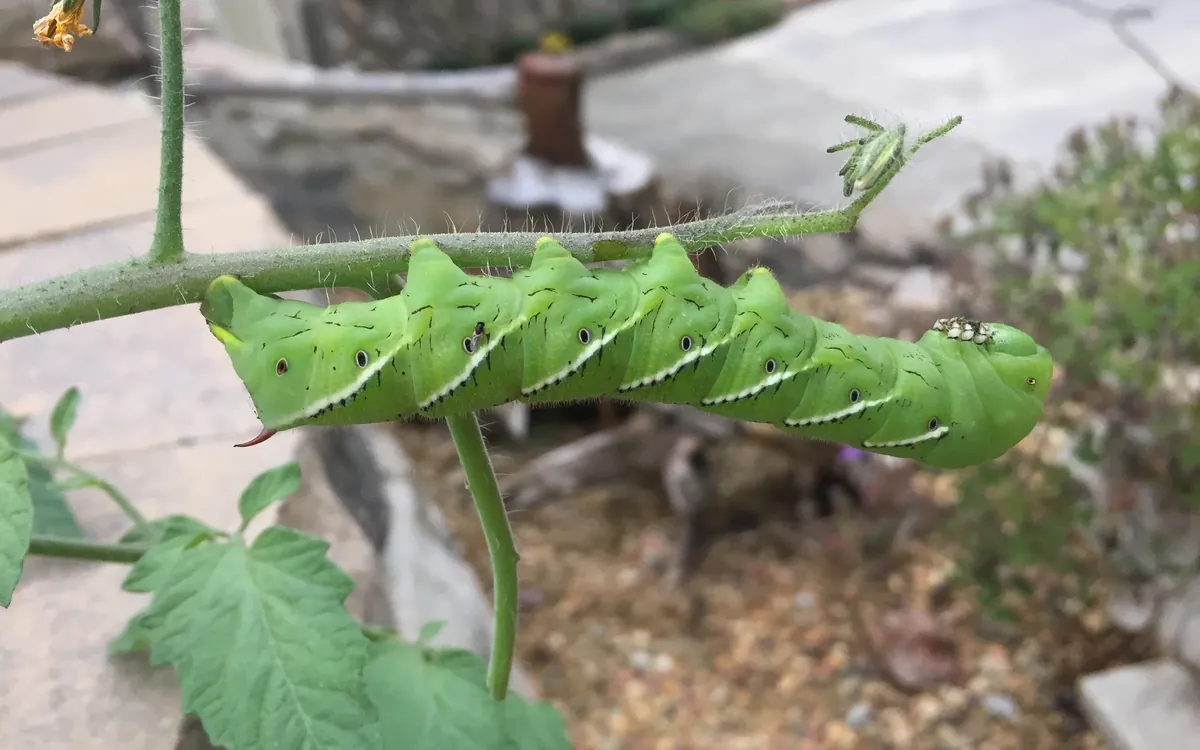
Hornworms are the largest caterpillars commonly found in vegetable gardens — up to 4 inches long, green, with a distinctive horn on the rear. Two large caterpillars can defoliate a tomato plant rapidly. Adults are large sphinx/hawk moths that hover like hummingbirds at evening flowers. The two species are virtually identical in damage and management; tobacco hornworm is more common in the south, tomato hornworm in the north.
Where it lives: Across the US: tobacco hornworm mostly in the South, tomato hornworm mostly in the North
Triggers: Overwinter as pupae in soil. Adults emerge mid-May to June. Females lay 1-5 eggs per plant visit on leaf undersides; up to 2,000 total. 2-3 generations in NC, 2-4 elsewhere. Larvae feed 3 weeks through 5-6 instars; bulk of feeding in last instars.
Risk fades when: Feeding ends by early fall when mature larvae drop from the plant to pupate and overwinter in the soil, so pressure resets each season; fall tilling of the bed destroys up to 90 percent of overwintering pupae and lowers next year's numbers (UMN Extension, Wisconsin Hort, UMass Extension).
Hornworm caterpillar feeding on a tomato plant (resized, converted to WebP) — Photo:
Ljessee123
·
CC BY-SA 4.0
Verticillium wiltVerticillium dahliae
High
Disease
May–SepPeak window months: May, Jun, Jul, Aug, Sep.
A soil-borne fungus that gets into roots and clogs the plant's water plumbing, causing yellowing, wilt, and slow decline. Unlike Fusarium, Verticillium tolerates cooler soils — symptoms often show up in late spring before the soil really warms. The fungus has a huge host range (over 200 plant species including tomato, pepper, eggplant, strawberry, mint, and many ornamentals) and survives in soil as tiny structures called microsclerotia for 10+ years. Yellowing is usually more uniform across the plant than Fusarium's signature one-sided pattern. Cool weather pathogen — soil temperatures of 70-80°F are ideal, and infections often slow in mid-summer heat.
Triggers: Cool-soil pathogen, active at 70-80°F soil temperatures. Symptoms often appear in late spring or early summer before soil warms past 85°F. Activity slows in mid-summer heat.
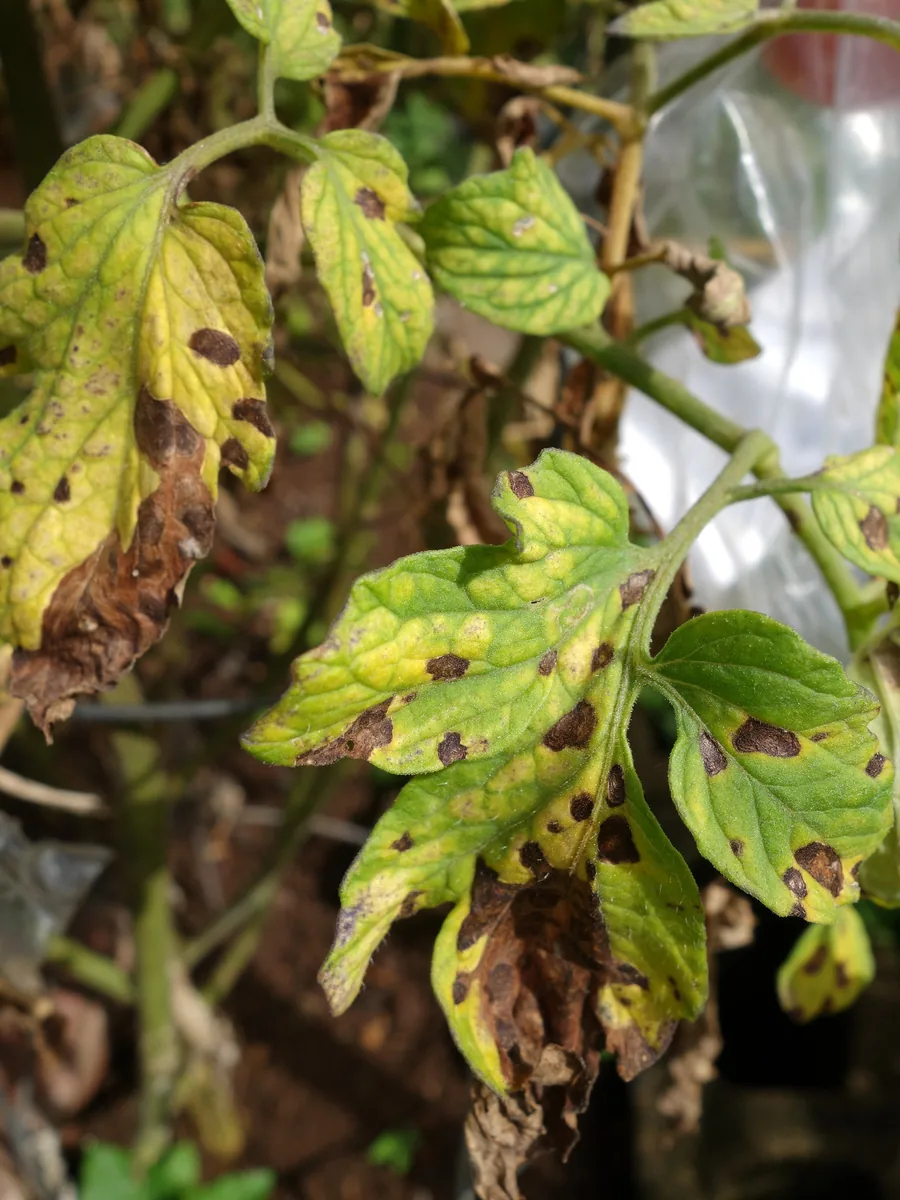
What it looks like: Older leaves show yellow V-shaped patches that start at the leaf edge and narrow inward, then turn brown and die. Slicing the stem near the base shows a light tan streak inside. Plants rarely die but lose vigor and yield.
Disease or overwatering? Yellow V shapes on older leaves with light tan streaking low in the stem point to Verticillium. Fusarium is very hard to tell apart, though its streaks are dark brown and run far up the stem; a lab test confirms either. Overwatering yellows lower leaves evenly with no V shapes or stem streaks.
Will it recover? Affected leaves don't recover, but the plant usually lives and keeps producing, just less. Next time, grow varieties resistant to race 1, wash soil off tools and rotate to grains or corn.
Risk fades when: Activity slows when soils warm above 85°F. The seasonal pressure fades, but the pathogen itself persists in soil for 10+ years.
Alternaria stem cankerAlternaria alternata f. sp. lycopersici
Moderate
Disease
Apr, May, Jun, Sep, OctPeak window months: Apr, May, Jun, Sep, Oct.
A fungal disease distinct from early blight that causes dark sunken cankers on tomato stems, usually at or just above the soil line. The cankers can girdle the stem and kill the whole plant. A toxin (AAL toxin) produced by the fungus also causes blackened V-shaped lesions on leaves. Found mostly in greenhouse and warm humid growing conditions. The resistance gene Asc is widely bred into modern tomato cultivars, making this disease uncommon on coded varieties but devastating on heirlooms in conditions that favor it. Worse in cool wet weather following plant stress.
Triggers: Disease activity peaks during cool wet weather following plant stress. High humidity and overhead watering accelerate spread. Most damaging in greenhouse settings.
What it looks like: Dark brown to black patches with ring-like bands form on stems near the soil line or higher up. On leaves, the fungus's toxin kills tissue between the veins, leaving dark brown to black dead areas. Green fruit gets dark brown sunken spots with rings.
Disease or overwatering? Ringed cankers on the stem plus dead tissue between leaf veins point to stem canker. Early blight makes round target spots on the leaves themselves rather than dead areas between veins. Overwatering wilts and yellows the plant with no stem cankers.
Will it recover? Cankers keep growing, circle the stem and kill the plant before harvest, so it can't be saved. Next time, grow a resistant variety; many are available.
Risk fades when: Three consecutive dry days above 75°F break the immediate infection cycle. Active cankers persist on infected plants.
May, Jun, Sep, OctPeak window months: May, Jun, Sep, Oct.
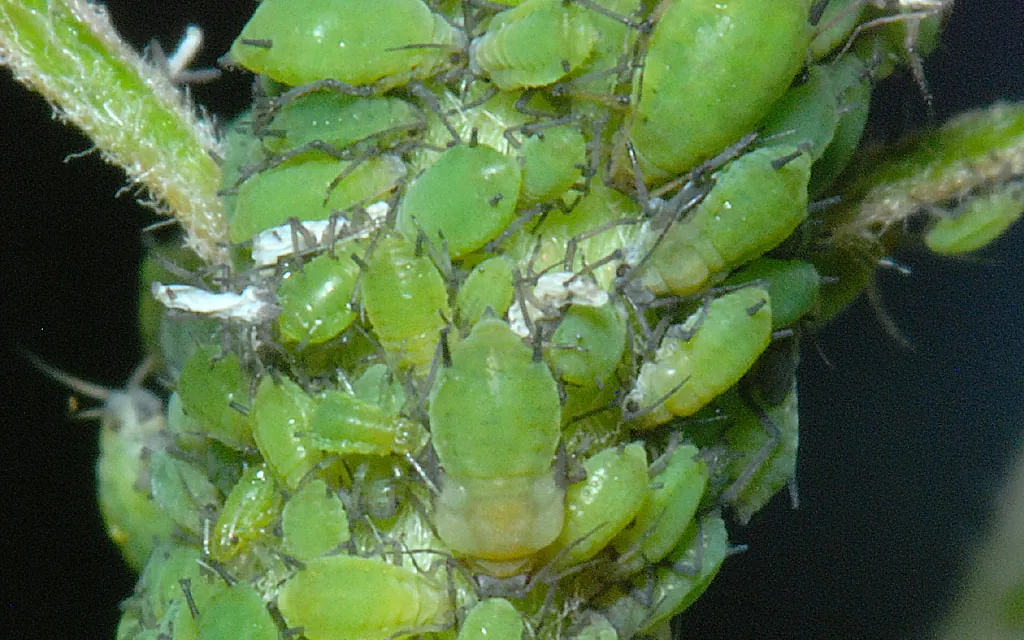
Aphids are soft-bodied sap-sucking insects that cluster on tender new growth. Most established plants tolerate moderate populations and will outgrow damage on their own, but aphids are the most important plant virus vectors in the garden, transmitting more than 100 plant viruses including potato leafroll, cucumber mosaic, and turnip mosaic. Honeydew excreted while feeding supports sooty mold growth and attracts ants that protect aphids from natural enemies.
Where it lives: Throughout the United States
Triggers: Optimal development at ~75°F (green peach aphid) per UC IPM Floriculture; melon aphid develops fastest above 75°F. Many species heat-intolerant above 90°F and crash in mid-summer. Soft new growth and over-fertilization with high N favor population buildup. Females give live birth parthenogenetically most of growing season — one generation in ~1 week under optimal conditions.
Risk fades when: Per UC IPM and Clemson HGIC, populations crash in mid-summer heat (>90°F) for many species, return in cooler conditions
Aphis pomi (green apple aphid) colony on crab apple stem (resized, converted to WebP) — Photo:
InfluentialPoints
·
CC BY 3.0
Bacterial spotXanthomonas spp.
Moderate
Disease
May–SepPeak window months: May, Jun, Jul, Aug, Sep.
A bacterial disease that puts small dark spots on the leaves and fruit of tomatoes and peppers. It spreads through splashing water, so it shows up more in warm, wet summers when rain or overhead watering keeps foliage wet.
Triggers: Conditions favor it when daytime highs sit in the 75-86°F range with frequent rain and high humidity. The bacteria sneak in through natural openings on the plant and through any wounds.
What it looks like: Spots start as water-soaked areas, mostly on older leaves, and change from yellow or light green to dark brown or black. Older spots are black, slightly raised, sit on the surface and grow up to about 1/3 inch across. On green fruit, spots start slightly sunken with a water-soaked ring that soon fades, then grow, turn brown and go scabby.
Disease or overwatering? Small black raised spots on leaves plus scabby spots on fruit point to bacterial spot. Wilting with general yellowing and no spots points to too much water.
Will it recover? Spotted leaves and fruit don't recover. Copper sprays give only partial control when started at the first spots. Next time, use disease-free seed and transplants, avoid overhead watering and rotate to a crop outside the tomato family.
Risk fades when: NC State notes it's less of a problem in dry years. There's no published dry-day reset, so SoilStack uses a conservative 4 dry days — longer than most diseases because several Xanthomonas species are involved.
Bacterial leaf spot caused by Pseudomonas cichorii — Photo:
Scot Nelson
·
CC0 1.0
CatfacingCatfacing is the term for tomato fruit that develops puckered scars, deep folds, holes, or zippered scarring at the blossom end.
Moderate
Physiological
May–JunPeak window months: May, Jun.
Catfacing is the term for tomato fruit that develops puckered scars, deep folds, holes, or zippered scarring at the blossom end. The mechanism is disrupted flower development during the cool early-spring weather when fruit was setting. Temperatures below 58°F during flowering can cause flower parts to fuse to the developing ovary, creating scar tissue that becomes visible as the fruit grows. Most common on the first cluster of fruit when set during cool weather, and on large-fruited beefsteak and heirloom cultivars; small-fruited cherry and grape tomatoes rarely catface. Sometimes also triggered by exposure to 2,4-D or other broadleaf herbicide drift from nearby lawn applications. Affected fruit is fully edible — just cut around the scarring.
Triggers: Per Iowa State/Purdue Extension: cool weather during flower development (below 58°F during bloom) is the primary cause. Affects first-cluster fruit set in cool springs most often. Large-fruited cultivars (beefsteak, heirloom paste) much more susceptible than cherry/grape. 2,4-D drift mimics symptoms.
Risk fades when: Catfacing affects fruit that was setting during the cool weather; later clusters set in warmer conditions are normal. No corrective action needed for the plant — affected fruit is still edible, just cosmetically damaged.
Early blightAlternaria solani
Moderate
Disease
May–SepPeak window months: May, Jun, Jul, Aug, Sep.
A common late-season tomato disease that shows up as distinctive bull's-eye spots starting on the lowest leaves and creeping upward. Plants rarely die from it, but yield drops as more leaves get infected. The same conditions, crops, and treatments apply to septoria leaf spot — both look like leaf spots on tomatoes during warm, wet weather and respond to the same management.
Triggers: Develops from 59°F upward and is worst at 82-86°F, its optimum (UMN). The spores need either standing water on the leaf or 90%+ humidity for 5-10 hours straight to germinate.
What it looks like: Small dark spots on the oldest leaves near the ground, growing into round brown spots up to 1/2 inch across with target-like rings, and the leaf around them often turns yellow. Stems on older plants get dry brown patches with dark rings. Fruit gets leathery black spots with raised rings, usually near the stem end, and may drop.
Disease or overwatering? Brown spots with target rings, starting low and moving up, point to early blight. Septoria spots are smaller, with dark borders and tan to gray centers and no rings. Yellowing without spots points to too much water.
Will it recover? Spotted leaves don't recover. Remove affected lower leaves, up to a third of the plant, and keep it producing from healthy growth; most home gardeners don't need a fungicide. Next time, grow resistant varieties, mulch the soil, water at the base, stake for airflow and stay out of wet plants.
On Yellow Pear: Fungal, more vulnerable due to zero resistance
Prevention: Wider spacing for airflow, mulch, prune lower leaves, and use copper only when a disease alert is on
Risk fades when: Three consecutive dry days break the moisture cycle the spores need to keep spreading. Existing leaf damage stays, but new infections stop.
Fruit crackingTomato cracking happens when fruit expands faster than the skin can stretch.
Moderate
Physiological
Jul–AugPeak window months: Jul, Aug.
Tomato cracking happens when fruit expands faster than the skin can stretch. The trigger is almost always a sudden change in water supply — heavy rain or watering after a dry period — that lets the fruit swell rapidly while the skin can't keep up. Two patterns: radial cracks (lengthwise from stem toward bottom) are the more serious type and most common during hot humid weather; concentric cracks form rings around the shoulder. Larger fruits (beefsteak, paste) crack more than smaller ones, but cherry tomatoes also split when their high sugar concentration draws water in fast. Cracking is more likely on plants with light fruit loads (no competition for water means each fruit absorbs more), with thin canopies (sun heats the fruit and weakens skin), and during the ripening stage. Once cracked, fruit becomes vulnerable to fungi and bacterial soft rot; pick affected fruit immediately. Prevention: even soil moisture (mulch + steady watering), crack-resistant cultivars (Jetstar, Mountain Spring, Mountain Fresh), maintain leaf cover.
Triggers: Per Purdue/UDel/NCSU Extension: cracking results from skin growth rate < fruit expansion rate. Triggers: rain after drought (dominant), high temperature swings, high humidity, thin canopy exposing fruit to direct sun. Larger and cherry tomatoes both prone — cherry tomatoes from high sugar concentration drawing water rapidly. Modern hybrid varieties bred for crack resistance.
On Yellow Pear: Inconsistent watering
Prevention: Drip irrigation, consistent deep watering, mulch
Risk fades when: Pick cracked fruit immediately to prevent secondary rot. They're still edible if trimmed. Adjust irrigation to stay consistent moving forward — mulch helps even out soil moisture between rains and waterings.
A fungal disease that creates small dark spots on tomato leaves which then turn gray in the center and develop a glassy or cracked appearance. Older leaves drop early, exposing fruit to sunscald. Common in warm humid weather, especially in southern states and in greenhouse production. Spreads by splash and wind during wet weather. Resistance (coded St) is widely available in modern hybrid tomatoes — heirlooms generally lack the gene. Doesn't usually kill plants outright but causes significant defoliation and yield loss.
Triggers: Disease favored by warm humid weather with persistent leaf wetness. Most active at 75-80°F with high humidity. Long dew periods and overhead irrigation accelerate spread.
What it looks like: Many small round to oval gray to black specks on both sides of the lower leaves. Spots grow across the veins, crack in the middle and run together, the leaf often yellows, and leaves drop. Fruit is not spotted, but leaf loss cuts fruit quality and yield.
Disease or overwatering? Small gray to black specks that crack in the middle and appear on the lower leaves only point to gray leaf spot. Early blight spots grow much larger with target rings; Septoria spots have dark brown edges, tan to gray centers and show on stems too. Yellowing with no spots points to too much water.
Will it recover? Spotted leaves don't recover and tend to drop. Next time, grow a resistant variety, which is the most effective control, clear weeds and volunteer tomatoes before planting, and keep tomatoes and peppers out of that bed for at least 3 years.
Risk fades when: Three consecutive dry days break the active infection cycle. Existing spots persist.
May–SepPeak window months: May, Jun, Jul, Aug, Sep.
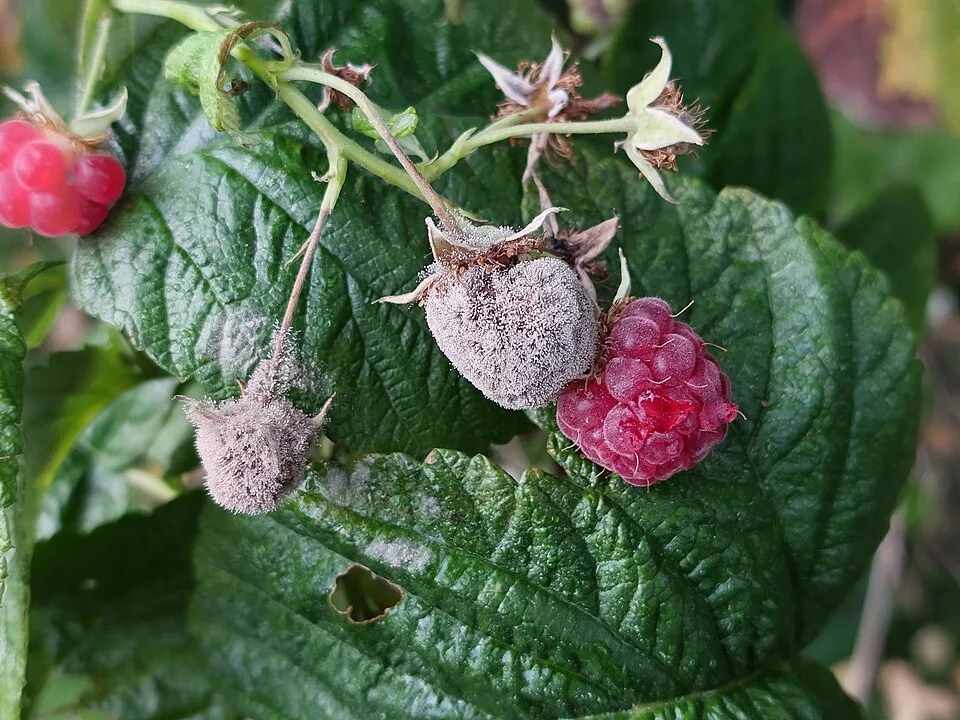
Fuzzy gray mold on flowers, fruit, and wounded tissue. It thrives in cool, humid, enclosed spaces — University of Minnesota notes this is unlikely to be a problem in open home gardens and rare even in field tomatoes. It's mostly a greenhouse and high-tunnel concern, included here because SoilStack supports those growing environments.
Triggers: Develops at 60-75°F with humidity above 80%. Infection requires 5-8 hours of standing water on the plant tissue. UMN's data shows it's unlikely in open home gardens.
What it looks like: Gray-brown velvety mold covers stems, leaves, dying flowers and the cap of the fruit. Stem infections can circle the stem and wilt everything above. Green fruit rots to light brown or gray, starting where it touches other infected parts. Small green fruit hit directly by spores often doesn't rot but shows pale circular rings called ghost spots.
Disease or overwatering? Gray fuzzy mold on dying flowers, fruit caps or stems points to gray mold, and white rings on green fruit are ghost spots from the same fungus. Wilting with yellowing and no mold points to too much water.
Will it recover? Rotted tissue doesn't recover, and fungicides won't stop an infection that is already established. Remove badly affected plants. Next time, check transplants before planting, skip unneeded late watering and keep the soil surface dry once fruit sets.
Risk fades when: Temperatures above 82°F suppress growth and spore production. That's the published threshold.
Raspberry fruit with gray mold (Botrytis cinerea) infestation (resized, converted to WebP) — Photo:
Schlaghecken Josef
·
CC BY 4.0
Potato virus YPotyvirus (Potato virus Y, PVY)
Moderate
Disease
Year-roundPeak window months: Jan, Feb, Mar, Apr, May, Jun, Jul, Aug, Sep, Oct, Nov, Dec.
An aphid-transmitted virus that affects pepper, potato, tomato, eggplant, and tobacco. Symptoms include mottled or vein-yellowing leaves, leaf distortion, and reduced fruit set. Aphids acquire the virus in seconds when feeding on infected plants and transmit it to healthy plants almost immediately afterward — this 'non-persistent' transmission means insecticides rarely stop the spread fast enough. The virus has multiple strains (common, necrotic, others) varying in severity. Resistance (coded PVY) is widely available in modern pepper hybrids.
Triggers: Transmitted by aphids; SoilStack uses warm, dry, aphid-favorable weather as proxy. Peak transmission risk during periods of aphid colony growth (spring and early summer).
Root knot nematodeMeloidogyne spp. (M. incognita, M. hapla, M. javanica, M. arenaria)
Moderate
Disease
May–SepPeak window months: May, Jun, Jul, Aug, Sep.
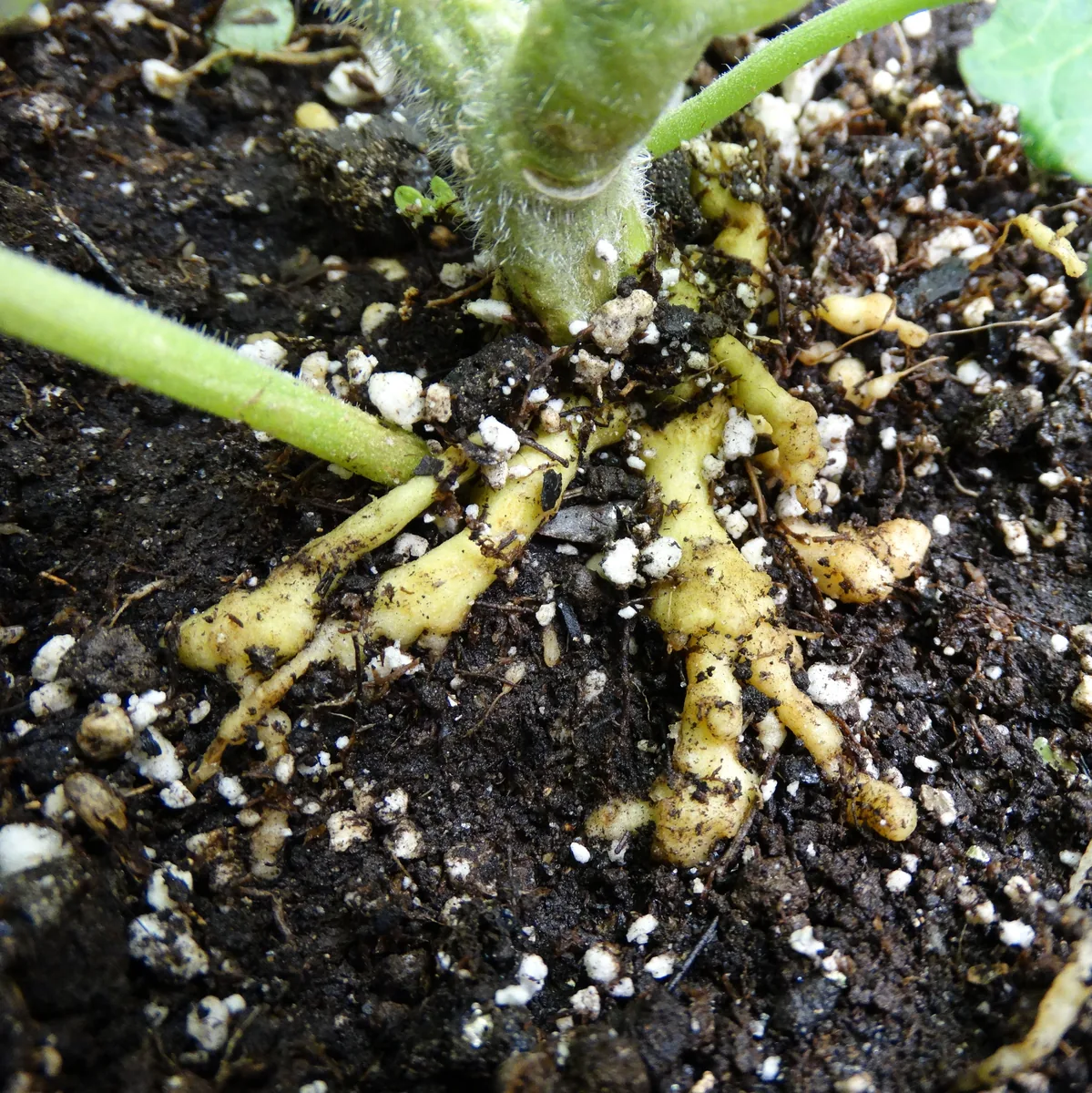
Microscopic soil-dwelling roundworms that burrow into plant roots and cause swollen knots (galls). Above ground, the plant looks stunted, yellowed, and wilted even with plenty of water. They attack over 2,000 plant species, so almost nothing is safe. They're most active in warm soil (70-85°F) and do more damage in sandy soils, where they move easily. Once a bed has them, populations stick around for years.
Triggers: Soil temperatures of 70-85°F are ideal for them; below 60°F they go dormant. Sandy soils make it easy for them to move and reproduce, while heavy clay slows them down considerably. In warm soil, a full generation completes in about 27 days.
What it looks like: Plants are weaker than their neighbors, may turn yellow and wilt in hot weather, often in patches, especially in sandy soil. Pull one up: the roots carry knobby swellings (galls), from small bumps up to about 1 inch across.
Disease or overwatering? Swollen galls on the roots point to root-knot nematodes. Overwatering yellows and wilts plants but leaves roots without galls, so pulling a plant settles it.
Will it recover? Infected plants stay less vigorous and wilt more easily in hot weather. Next time, grow nematode-resistant varieties, rotate with resistant varieties and crops nematodes don't feed on, keep weeds down, and consider solarizing the soil.
Risk fades when: Activity drops sharply once soil cools below 60°F. Damage stops accumulating for the season, but the population stays in the soil and returns when warmth does.
A tomato-specific Septoria disease (not the same as the celery version). It produces many small spots with dark margins and tan or gray centers — look for tiny black specks (pycnidia) inside each spot. It usually starts on the lowest leaves after humid, rainy stretches. Note: Septoria leaf spot has no standardized resistance code on tomato seed packets. Seed companies that breed Septoria resistance (uncommon) typically spell it out as 'Septoria leaf spot' in the variety description rather than abbreviate.
Triggers: Favored by high humidity, heavy rainfall, splash from infected debris below the plant, and long stretches of leaf wetness.
What it looks like: Many small round spots, under 1/8 inch, with tan to gray centers and a dark brown edge, sometimes ringed in yellow, starting on the lower leaves and moving up the plant. Tiny dark specks sit in the center of each spot; these are where the fungus makes spores. Spots also form on stems and leaf stalks but rarely on fruit, and heavily spotted leaves die.
Disease or overwatering? Lots of small tan spots with dark edges and dark specks in the center point to Septoria. Early blight spots are larger, darker brown and have target rings; gray leaf spot centers crack open or fall out. Yellowing with no spots points to too much water.
Will it recover? Spotted leaves don't recover and can die off as spots merge, but the plant keeps producing from healthy upper growth. Remove affected lower leaves without stripping the plant. Next time, rotate tomatoes to a different bed each year, mulch to stop soil splashing onto leaves and, if needed, use a preventive fungicide before spots appear.
On Yellow Pear: Fungal, common in humid climates
Prevention: Avoid overhead watering, remove infected leaves, and use copper only when a disease alert is on
Risk fades when: Dry foliage with no splash events interrupts the new infection cycle from lower leaves and debris. Existing spots stay, but spread stops.
Tomato Septoria leaf spot caused by Septoria lycopersici — Photo:
Scot Nelson
·
CC0 1.0
Spider mitesTetranychus urticae (two-spotted spider mite, most common); also broad mite (Polyphagotarsonemus latus), russet mite (Eriophyidae)
Moderate
Pest
Jul–AugPeak window months: Jul, Aug.
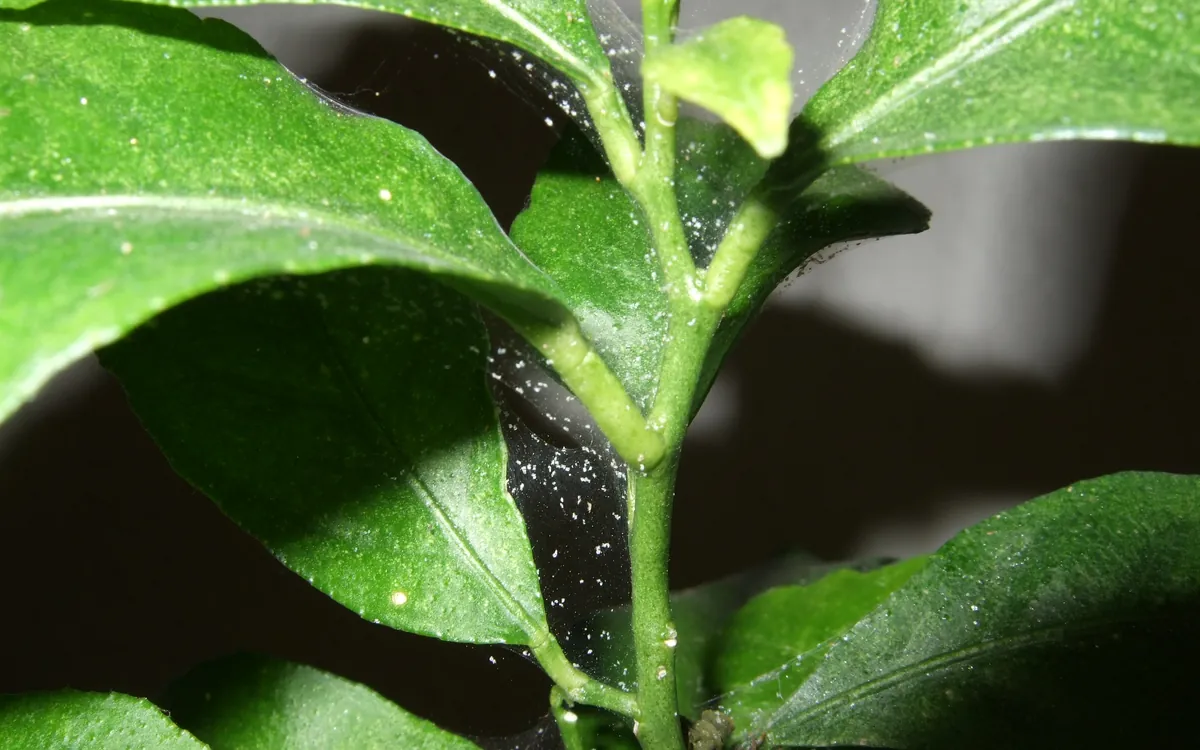
Spider mites are tiny arachnids (1/50 inch) that feed on the undersides of leaves, producing characteristic silver-yellow stippling. Heavy populations produce visible webbing that interferes with pesticide coverage. They thrive in hot dry weather and drought-stressed plants. The two-spotted spider mite feeds on more than 180 cultivated plant species.
Where it lives: Throughout the United States
Triggers: Hot dry conditions; >90°F lifecycle <2 weeks. Drought stress amplifies. Broad-spectrum sprays (carbaryl, pyrethroids) trigger outbreaks by killing predators. Wisconsin Ext: 'as little as a month without significant rain during the growing season can favor a mite outbreak.'
Risk fades when: Populations build in hot, dry weather and then crash in late summer and fall as predatory mites catch up, host foliage declines, and cooler, wetter weather and rain set in, so risk fades once the heat and drought break (UC IPM, Colorado State Extension).
Spider mite (Tetranychidae) infestation with webbing on a young lemon plant (resized, converted to WebP) — Photo:
Paramecium
·
CC BY-SA 3.0
SunscaldPhotooxidative sunscald necrosis
Moderate
Physiological
Jul–AugPeak window months: Jul, Aug.
Sunscald shows as pale white or yellowish blotches on the side of fruit facing the sun, usually appearing during heat waves above 95-100°F. The fruit can't dissipate heat fast enough and the surface cells die. Most often happens after sudden foliage loss — a leaf disease (early blight, septoria) defoliates the plant, removing the shade canopy, and previously-protected fruit is suddenly exposed. Aggressive pruning has the same effect. Storm damage or wilt diseases (Verticillium, Fusarium) that kill foliage also trigger it. Tomatoes show pale yellow-white patches that eventually become blistered and paper-thin. Peppers get tan mushy lesions. Once damaged, the fruit can't heal but secondary fungal/bacterial rots often colonize the dead tissue, so remove affected fruit. Prevention: keep foliage healthy, avoid late-season heavy pruning, mulch to keep plants vigorous, use shade cloth during forecast heat waves.
Triggers: Per U Illinois IPM RPD 939: sunscald most common during heat waves >100°F when fruit suddenly loses shade cover. Common triggers: late-season pruning, leafspot disease defoliation, Verticillium/Fusarium wilt, storm damage to canopy. Damage is photooxidative — cells can't manage the combined heat + UV load.
Risk fades when: Remove affected fruit before secondary fungi colonize the dead tissue. Maintain canopy health going forward. Future fruit on the same plant is fine if leaves regrow.
ThripsFrankliniella occidentalis (western flower thrips), F. tritici (eastern flower thrips), F. fusca (tobacco thrips), Thrips tabaci (onion thrips)
Moderate
Pest
Mar–MayPeak window months: Mar, Apr, May.
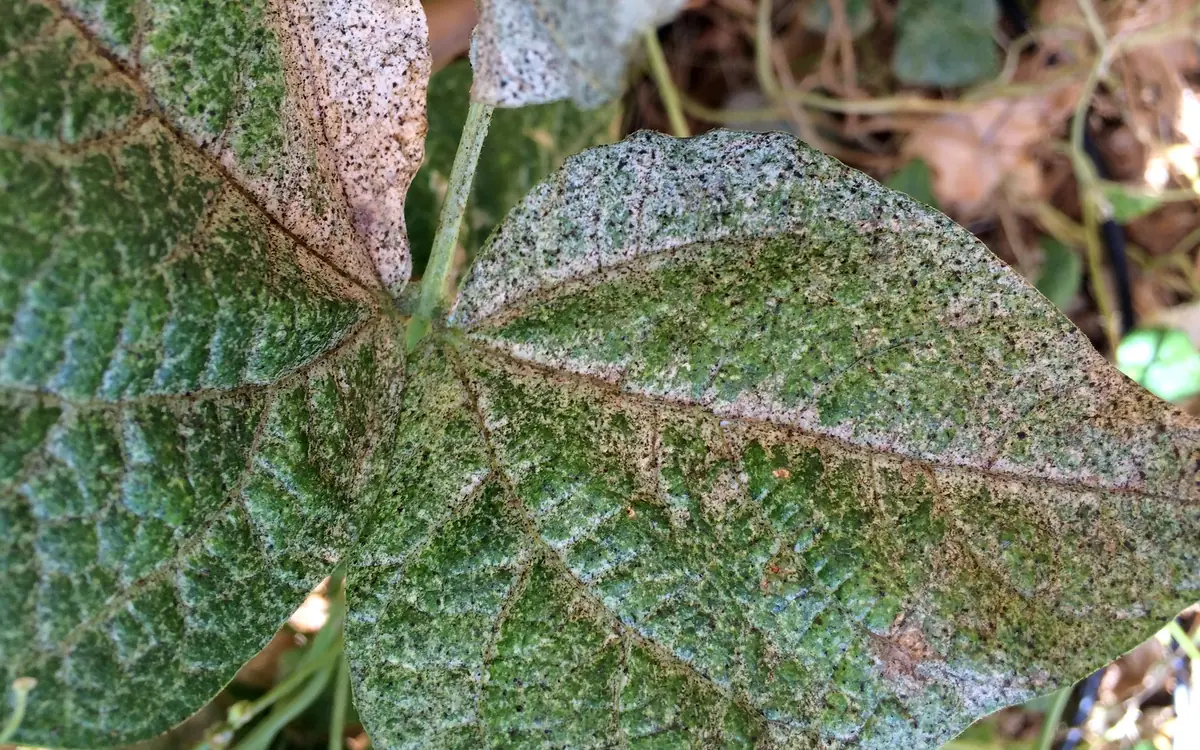
Thrips are tiny (1/16 inch) slender insects with fringed wings that puncture and rasp leaf surfaces, leaving silver stippling with black frass dots. The biggest concern is virus vectoring: western flower thrips is the principal vector of tomato spotted wilt virus (TSWV) and impatiens necrotic spot virus (INSV), which affect more than 600 plant species. Greenhouse and high tunnel infestations can be devastating.
Where it lives: Throughout the United States
Triggers: Hot dry weather; greenhouse/high tunnel environments. Female lays eggs inside leaf tissue. 2 larval stages feed; 2 non-feeding pupal stages in soil/litter. Lifecycle 10-21 days. Many overlapping generations. Bridge crops (spring wheat, peach, strawberry per NC State) build populations before vegetable hosts available.
Risk fades when: Infestations are worst in hot, dry weather; cool conditions slow development and heavy rain or overhead irrigation knocks populations down sharply, so risk fades as the weather turns cool and wet and rebuilds the following spring (UK Entomology, Cornell IPM).
Thrips feeding injury on pole bean leaves — silvery stippling with dark fecal specks — Photo:
Scot Nelson
·
CC0 1.0
Year-roundPeak window months: Jan, Feb, Mar, Apr, May, Jun, Jul, Aug, Sep, Oct, Nov, Dec.
Another aphid-transmitted potyvirus, closely related to PVY. Primarily affects pepper but also tomato and tobacco. Symptoms include vein-yellowing, mottled leaves, and 'etched' appearance on leaves (small etched lines along veins giving the disease its name). Aphid transmission is non-persistent — virus acquired in seconds and transmitted almost immediately. Resistance (coded TEV) is widely available in modern pepper hybrids and often paired with PVY resistance.
Triggers: Aphid-transmitted; same proxy conditions as PVY.
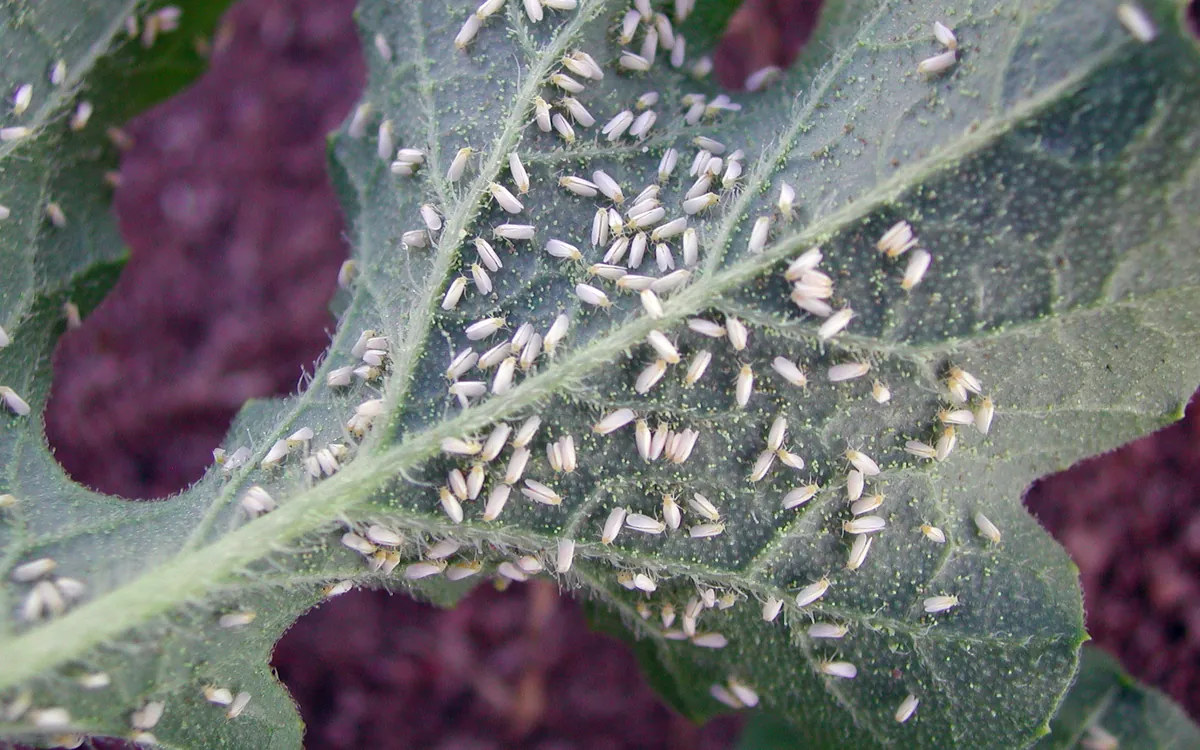
Tiny sap-sucking insects that erupt off the leaf in a white cloud when you brush the plant. Despite the name they are not flies at all - they are Hemiptera, relatives of aphids, scales and mealybugs, and the name comes from the mealy white wax coating the adult's wings and body. They pierce the phloem and drain sap, so heavy populations yellow the leaves, dry them, and drop them. The bigger nuisance is honeydew: a sticky sugary excretion that coats the foliage, grows black sooty mold, and draws ants, which then chase off the natural enemies that would otherwise keep whitefly in check. UC IPM notes outbreaks often begin exactly that way - when biological control gets disrupted - and that once populations are high the pest is genuinely hard to manage. Bemisia nymphs go further, causing distortion, discoloration, and the leaf silvering that gives silverleaf whitefly its name. Both species vector plant viruses. Indoors and under cover they are far worse than in the open garden, because it never gets cold enough to knock them back and their generation time collapses to about 18 days at 80-90°F. The single highest-value habit is inspecting every new plant, undersides included, before it enters the greenhouse or the garden.
Where it lives: Across the US in summer; outdoors all year only where winters do not freeze
Triggers: UC IPM: whiteflies become abundant in vegetable and ornamental plantings especially during warm weather, and outbreaks often occur when natural biological control is disrupted. Greenhouse whitefly develops egg to adult in as little as 18 days, with fastest development between 80 and 90°F, so populations compound quickly under cover or on overwintered indoor plants. They favor succulent, actively growing tissue. Host range is broad - UC IPM lists alfalfa, beans, cucumbers, eggplants, grapes, lettuce, melons, peas, peppers, potatoes, strawberries, tomatoes and many ornamentals. Ants tending the honeydew interfere with the natural enemies that would otherwise suppress them.
Risk fades when: UC IPM: abundant especially during warm weather. Development is fastest at 80-90°F, so protected culture and indoor overwintering sustain populations outside the normal outdoor season - which is exactly when houseplants and tender herbs brought inside get hit.
Silverleaf whitefly (Bemisia tabaci) adults on the underside of a watermelon leaf (cropped, resized, converted to WebP) — Photo:
CSIRO
·
CC BY 3.0
WirewormsElateridae (click beetle larvae; several genera, including Conoderus, Melanotus and Limonius)
Moderate
Pest
Apr, May, Jun, Aug, Sep, OctPeak window months: Apr, May, Jun, Aug, Sep, Oct.
Wireworms are the larvae of click beetles. They live in the soil, eating seeds, seedlings, roots and tubers, and they bore small holes and tunnels into potatoes and sweet potatoes that can make them unusable. For home-garden sweet potatoes, UGA Extension says wireworms and root-knot nematodes seem to be the biggest problems. Their main food is the roots of grasses, so the worst damage comes in gardens dug out of sod or lawn within the past few years. Some kinds take several years to grow up, so a problem bed can stay a problem for years. Severe outbreaks are rare, and once you see damage no spray will fix it: the steps that work are taken before planting.
Where it lives: Found across the US; different wireworm species are the main pests in different regions
Triggers: Larvae and adults spend the winter 9 to 24 inches deep in the soil. In spring, once the soil warms to about 50 F, larvae feed within the top 6 inches; when the soil gets too hot (above 80 F) or dry they go deeper, and as the soil cools in fall they may feed near the surface again. They like moist, cool, heavy soil. Female click beetles lay eggs in grassy, weedy areas, which is why ground that was sod or lawn has the most wireworms. How long one generation takes depends on the kind: from one to six years. The corn wireworm takes up to six years, so larvae of every size are in the soil at once. In the Southeast, the southern potato wireworm has one or two generations a year and the tobacco wireworm has one.
Risk fades when: Wireworms do most of their damage in early spring, when they are near the soil surface; in summer they move deeper, and as the soil cools they may feed near the surface again (NDSU Extension). They become active and look for food as soon as the soil warms in spring (UMass Extension). In the Southeast, wireworms usually attack potatoes and sweet potatoes late in the season (Clemson HGIC; NC State Extension). The month numbers are a reading of 'spring' and 'late season' for most of the US; spring comes earlier in the South and later in the North.
Yellow shoulder appears as yellow or green firm patches on the shoulders (top) of ripening tomato fruit while the rest ripens normally. The cause is sustained high temperatures during ripening — above 86°F prevents proper formation of lycopene (the red pigment) in the shoulder tissue. Some cultivars are far more prone to it than others; older heirloom varieties and yellow-shouldered hybrids show it more. Sometimes called 'green shoulder' or 'gray wall' in literature. The affected tissue stays firm and is edible — just less flavorful than fully ripened tissue. Cut around it for a usable fruit. Cultivar choice is the main long-term fix; modern hybrids bred for heat tolerance show less yellow shoulder.
Triggers: Sustained high temps during ripening (>86°F) prevent lycopene synthesis in fruit shoulders. Sunscald exposure compounds. Some varieties always show it; modern hybrids less prone. Potassium deficiency may contribute.
Risk fades when: Affected fruit is edible — cut around the yellow patches. Cooler weather restores normal ripening. Long-term, choose modern hybrid varieties with heat-tolerant ripening.
23 more issues below · Show all 33 ↓
Feeding & picking
Nutrition & Harvest
How hungry the plant is, what ripe harvest looks like, and how long the crop keeps after picking.
Fully colored bright yellow with no green remaining. Slight give when squeezed. Pear shape should be fully developed, 1-2 inches long, ½-1 inch wide.
Yellow Pear is climacteric, which means it keeps ripening after it is picked. You can harvest at first blush ahead of a frost and let it finish indoors.
Ripe fruit is yellow rather than red. Waiting for it to redden leaves it overripe.
Ripens after picking?Yes
Color when ripeYellow
Expected yield8–12 lbs/plant
Storage5 days — Counter at room temp stem-side down. Never refrigerate.
Roots release alpha-terthienyl and related compounds that can suppress root-knot nematodes (microscopic soil worms) when marigolds are grown densely enough for active root/nematode interaction.
Most effective as a dense cover-crop-style stand for a full season before rotating to vegetables. Casual interplanting does not control nematodes.
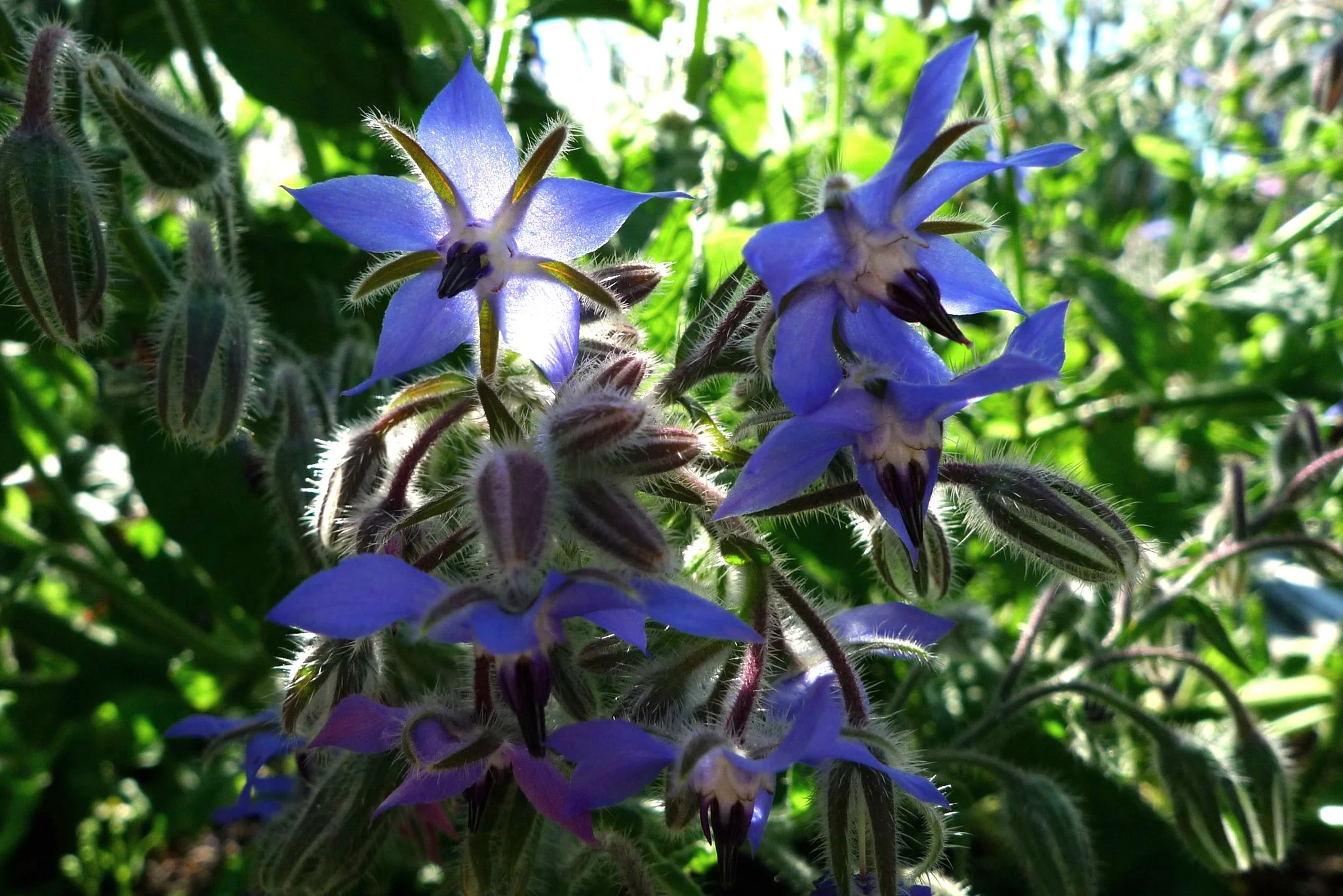
Produces abundant nectar over a long bloom period and attracts honeybees, bumblebees, and native bees.
UMN strawberry pollination study, confirmed increased pollinator visits near borage
Beneficial insectsResearch supported
Attracts parasitic braconid wasps (natural enemy of tomato hornworm), nabid bugs, hoverflies. Host plant for lacewings.
Journal of Apicultural Science 2020
Pest deterrent
Can help against hornworms and cabbage worms indirectly. The flowers draw in small wasps that lay eggs inside the caterpillars and kill them. This only works where those wasps already live, so it is not guaranteed in every garden.
The widely repeated claim that borage scent repels tomato hornworms has no controlled study behind it. What is supported is parasitoid recruitment, which is a different mechanism and is covered by this plant's beneficial-insect-habitat function. Direct repellence would require close planting; predator recruitment works at garden scale.
Soil buildingExtension recommended
Leaves are high in potassium and calcium and break down fast, which makes them good compost material or chopped mulch around other plants.
That idea, called dynamic accumulation, traces to a single page in a 1986 book and has no research behind it. A Cornell field trial found that what a plant holds simply tracks what is already in the soil around it. The compost and mulch value is real and is what remains.
University of California ANR, garden myths review (dynamic accumulators)
Frost warnings, zone-specific timing, and seasonal nudges -- sent only when there's something to act on. Free, unsubscribe anytime.
Get Personalized Planting Reminders
Frost-date reminders, zone-specific tips, and seasonal guidance. Free, unsubscribe anytime.
What you'll need
Growing Supplies
Hand-picked for your Yellow Pear, with the extension research behind every recommendation.
Seed starting tray + heat mat
For crops started indoors before transplanting, this tray-and-mat combo improves germination consistency. Bottom heat speeds and evens germination; warm-season crops in particular want it, while cool-season transplants germinate fine at the lower end of the range. Look for a rigid tray, cell inserts with drainage, and a mat paired with a thermostat.
Source: Utah State University Extension; Iowa State University Extension; Mississippi State University Extension
University of Maryland Extension says most gardeners prefer staking, trellising, or caging tomatoes because it uses less space, reduces fruit rots, makes harvesting easier, and increases yield per garden area; Clemson Extension adds that cages improve air circulation and reduce disease spread. For indeterminate tomatoes that keep elongating and setting fruit all season, a heavy cage is a structural need, not just a convenience, because it keeps foliage and fruit off the soil while supporting continuous vertical growth.
Source: University of Maryland Extension; Clemson Cooperative Extension
Nearly every garden benefits from mulch for weed suppression, moisture conservation, and soil temperature moderation. For most home gardeners, quality organic mulch is the better buy over landscape fabric.
Source: Penn State Extension; Wisconsin Horticulture; Illinois Extension
Every gardener benefits from putting water at the root zone instead of on the leaves, because drip and soaker systems reduce foliar disease pressure by limiting leaf wetness and soil splash. A quality kit should include a backflow preventer, filter, pressure reducer, and UV-resistant tubing.
Source: Iowa State University Extension; Colorado State University Extension; UMass Extension
UMN Extension recommends plastic mulch to warm soil for heat-loving crops and reports that red mulch has improved tomato yields by changing the quality of light reflected into the canopy, while black mulch also warms the root zone and suppresses weeds.
Row cover adds frost protection, speeds early growth, and physically excludes insect pests without spraying. Look for spun-bonded fabric with a stated weight and frost rating, UV resistance, and enough width for hoops or low tunnels.
Source: University of Maryland Extension; University of New Hampshire Extension; Colorado State University Extension
K-State Research and Extension and University of Maryland Extension recommend shade cloth as a heat-management tool for vegetable gardens, with 30 percent shade rating most effective for tomatoes, peppers, and fruiting crops, and 40 to 50 percent for protecting heat-sensitive greens during hot summer months. University of Delaware research found 30 percent black shade cloth tripled marketable yield for bell peppers compared to unshaded plants, and Purdue trials showed shade cloth reduced maximum daily temperatures by 8 to 10 degrees Fahrenheit. Choose knitted polyethylene with reinforced grommets every 18 to 24 inches, mount on hoops or a frame with open sides for airflow, and remove or vent during prolonged wet weather to avoid increased humidity in the canopy.
Source: K-State Research and Extension; University of Maryland Extension; University of Delaware Cooperative Extension; Purdue University Extension
Reflective plastic mulch (white-on-black or silver)
North Carolina State Extension reports that white-on-black plastic mulch can reduce soil temperature by 5 to 20 degrees Fahrenheit and silver mulch by about 6 degrees, the opposite effect of black mulch which warms soil. This makes reflective mulch the appropriate plasticulture choice for hot zones (especially Zone 9a desert and other high-heat low-humidity areas) where overheating limits warm-season crop performance more than cold soil. Silver mulch adds documented aphid and thrips repellency from the reflective surface. Use only with drip irrigation installed underneath, never use plastic mulch without irrigation, and reserve for late spring or early fall plantings where the surrounding heat is the primary stress.
Source: North Carolina State Extension; University of Arizona Cooperative Extension
A soil test gives a baseline for pH and nutrient status so gardeners can add only what the soil actually needs. Prioritize a mail-in or lab-affiliated kit whenever possible because extension guidance notes that laboratory testing is more accurate than instant readers. Routine pH and nutrient tests do not include lead, so if you garden near an older painted building, a busy road or an old industrial site, ask your extension lab for a lead test (US EPA; University of Minnesota Extension). At 200 ppm lead or more, grow food in raised beds of clean soil, peel root crops, wash all produce, and keep children from eating soil (US EPA).
Source: University of Maryland Extension; Purdue Extension; Montana State University Extension; US EPA; University of Minnesota Extension
University of Minnesota Extension recommends measuring soil temperature 2 to 4 inches below the surface to decide when warm-season crops can actually be planted, because air temperature and average frost dates do not reliably predict whether soil is warm enough for germination. A dedicated soil thermometer with a 4 to 6 inch stainless steel probe gives gardeners a deterministic reading instead of relying on the calendar alone, which matters most in zones with wide last-frost variability. Look for a waterproof stainless steel stem, a clearly marked vegetable-garden temperature range, and a readable analog or digital display at planting depth.
University of Arizona Cooperative Extension notes that most vegetables root in the top 12 to 24 inches of soil and that hot, dry periods require more frequent irrigation, but watering by habit often wets only the top inch while leaving the root zone dry. A dedicated soil moisture meter with a long probe gives gardeners a deterministic reading at root depth instead of guessing from surface appearance, which is most critical in low-rainfall desert zones (Zone 9a Phoenix) and in raised beds or containers that dry from the top down. Look for a single-purpose moisture meter (not a 3-in-1 or 4-in-1 combo, which trade accuracy for feature count) with a probe that reaches 8 to 12 inches and a clear analog or digital display.
Source: University of Arizona Cooperative Extension
UF/IFAS Extension and Texas A&M AgriLife Extension recommend securing or removing trellises, shade cloth, hoop covers, container plants, and lightweight raised-bed accessories before tropical storms and hurricanes, since loose garden items become projectiles in high winds. Most-relevant for Gulf Coast Zone 8b (Houston, Mobile, New Orleans), Florida Zone 9b (Miami, Tampa), and any coastal area within the Atlantic and Gulf hurricane corridors. Galvanized steel ground anchors resist rust in humid coastal soils, and screw-in spiral anchors hold significantly better than driven stakes in saturated soil during storm conditions. Use quick-release fasteners on shade cloth and trellises so they can be removed quickly when a storm watch is issued.
Extension guidance favors bypass designs because they make cleaner, closer cuts on living tissue than anvil types. Look for hardened steel blades that can be sharpened, a comfortable grip, and a cutting capacity matched to real home-garden stems.
Source: University of New Hampshire Extension; Iowa State University Extension; Purdue University Extension
Raised beds improve drainage, let gardeners control soil from day one, reduce compaction, and make gardening more accessible. A quality kit should use rot-resistant, food-safe materials and provide enough depth for productive rooting. If your yard soil may hold lead, fill beds with clean soil over garden fabric (US EPA).
Source: Penn State Extension; University of Delaware Cooperative Extension; Illinois Extension
The most useful mix is three categories: a beginner guide, a reference manual for diagnosis and crop-by-crop lookup, and a soil science book. Look for region-aware editions, strong visuals, and evidence-based authorship.
As an Amazon Associate I earn from qualifying purchases. These are Amazon affiliate links -- if you buy through them, SoilStack earns a small commission at no extra cost to you. It's how we keep the app free and the calendar ad-free. We only link products that match what the research says you actually need.
Research
Sources
Reference material and extension guidance used to build this growing guide.