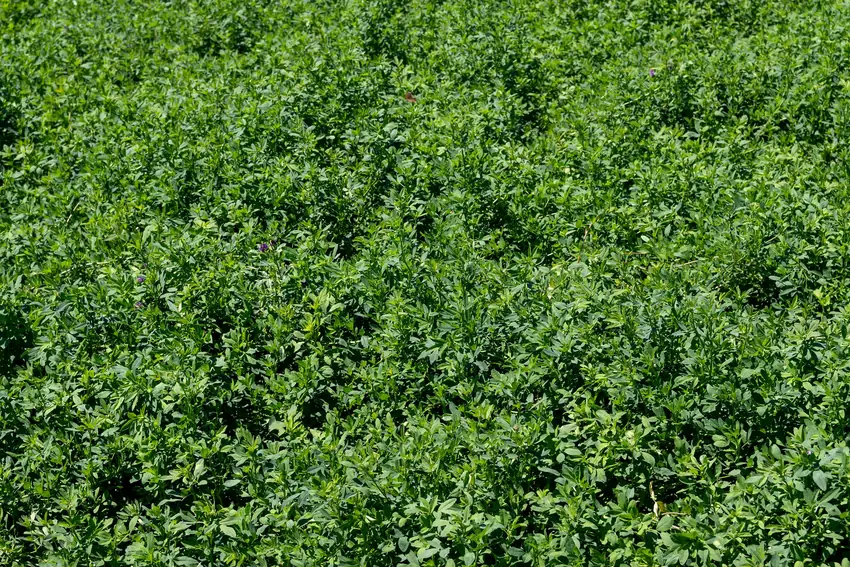
Alfalfa is a deep-rooted perennial legume used as a high-value soil-building and forage cover crop in well-drained beds. It develops a dense crown and taproot system that can mine nutrients from depth, improve soil structure, and fix nitrogen when properly inoculated. Because it dislikes wet feet and has strong autotoxicity, it is best used where a longer cover window and excellent drainage are available. Key facts: 60–70 days to maturity from direct sowing, 8+ hours of sun, 6–10" spacing. Not recommended for containers.
Updated June 1, 2026·Backed by 3 cited sources
Overview
At a Glance
The essentials first: timing, light, spacing, seed-starting, container fit, and overall size.
Days to maturity
60–70 days
from direct sowing
Sun
8+ hours
Full Sun, 8+ Hours
Spacing
6–10"
between plants
In practice
Dense stand establishment is preferred for weed suppression and uniform soil cover.
Seed start
0 weeks
before transplant
Container
No
Needs 7+ gal if attempted
Height
2–3 ft
at maturity
Planting window
Zone Planting Guide
Switch zones to see whether this plant is a strong fit, what frost timing looks like, and any extra notes worth planning around.
This card updates instantly with viability, frost timing, and any planting notes for your selected zone.
Care
Growing Guide
Everything in one place: seed starting, transplant timing, watering, soil, and structural support.
This crop holds the bed for longer than one season, so the sequence is not tied to a single calendar year.
1
Multi-season rotation window
Establish alfalfa where a longer soil-building interval is available; do not treat it as a quick turnover cover crop.
2
Stand year
Mow or cut periodically to manage growth and return biomass or remove forage; use for deep rooting, nitrogen fixation, and soil structure improvement.
3
Before returning bed to vegetables
Terminate thoroughly with tillage or other locally appropriate methods because perennial crowns can regrow.
4
After termination
Allow residue and crowns to break down before small-seeded crops; monitor for regrowth and avoid overclaiming quick nitrogen release.
Common questions
Alfalfa FAQ
Every answer is assembled from this cultivar's own record, so the figures match the rest of the page.
How many days to maturity for Alfalfa Cover Crop?
Alfalfa takes 60–70 days to reach maturity from direct sowing.
How far apart should you plant Alfalfa Cover Crop?
Space Alfalfa 6–10 inches apart, with 6–12 inches between rows.
How much sun do Alfalfa Cover Crop need?
Alfalfa needs at least 8 hours of direct sun a day.
How much water do Alfalfa Cover Crop need?
Alfalfa needs 0.75–1.5 inches of water a week, counting rainfall.
What soil pH do Alfalfa Cover Crop need?
Alfalfa grows best in soil with a pH of 6.5–7, ideally around 6.8.
How tall do Alfalfa Cover Crop get?
Alfalfa reaches 2–3 feet at maturity.
How do you start Alfalfa Cover Crop from seed?
Sow seed straight into the garden once the soil reaches 50°F.
What temperature do Alfalfa Cover Crop seeds need to germinate?
Alfalfa seeds germinate best at 65°F, within a workable range of 50–85°F, and take 7–14 days to emerge.
Can you grow Alfalfa Cover Crop in containers?
Alfalfa is not recommended for container growing. It would need at least 7 gallons if attempted, and compact varieties suit pots far better.
When is Alfalfa Cover Crop in season?
Alfalfa is a cool-season crop, in season during spring and fall in most regions. Plants reach harvest 60–70 days after direct sowing and prefer temperatures below 75°F.
Resilience
Plant Health
Stress tolerance, resistance notes, and the most common problems to watch for as plants mature.
Autotoxicity (alfalfa after alfalfa)Allelopathic self-inhibition (medicarpin implicated)
High
Physiological
Mar, Apr, May, Aug, Sep, OctPeak window months: Mar, Apr, May, Aug, Sep, Oct.
Alfalfa poisons its own seedlings. UMN Extension states it plainly: autotoxicity occurs when a mature alfalfa plant excretes a chemical that inhibits the germination and growth of seeded alfalfa. Wisconsin Extension identifies medicarpin as the compound most strongly implicated - water-soluble, more concentrated in top growth than in roots, and released into the soil from both living plants and decomposing residue once a stand is killed, whether by tillage, herbicide or winterkill. The effect is not subtle at close range. A classic University of Missouri study sowed alfalfa seed in a wagon-wheel pattern around an established plant: within eight inches, new seedlings rarely survived; between eight and sixteen inches they established but yielded poorly; beyond sixteen inches there was no effect. That radius is why the instinct to thicken a thinning stand by drilling more alfalfa into it fails so reliably - seedlings germinate, look acceptable, then die out over summer. The trait probably evolved in the dry Mediterranean, where suppressing nearby seedlings reduced competition for scarce water. Note that the evidence is not unanimous: a 2002 Agronomy Journal study found no consistent autotoxicity in the reseeding year.
Triggers: UMN Extension: alfalfa autotoxicity occurs when a mature alfalfa plant excretes a chemical that inhibits the germination and growth of seeded alfalfa. Management guidelines: allow at least one year between terminating an old alfalfa stand and reseeding alfalfa; do not thicken thinning stands of alfalfa with alfalfa; rotate from alfalfa to a grass crop to use residual alfalfa nitrogen; delaying spring reseeding two to four weeks after tilling a killed stand is NOT an effective strategy to alleviate autotoxicity and remains risky to establishment and yield. Wisconsin Extension: several potentially autotoxic chemicals are produced, one of which is medicarpin, present throughout the plant but more concentrated in top growth than roots; it is water-soluble and leaches readily into the soil from both decomposing plant material and growing plants. Once a stand is killed - by plowing, spraying or winterkill - the autotoxic compounds are released. Persistence depends on soil type, temperature and rainfall: on sandy soils effects are more acute but less persistent because the toxins leach; high rainfall leaches them more rapidly. The toxins are not present in the first year of a new seeding, so a failed or winterkilled new seeding can be reseeded without an autotoxicity effect. A University of Missouri study found that within 8 inches of an established plant new seedlings rarely survived; from 8 to 16 inches they established but productivity was greatly diminished; beyond 16 inches there was no impact. NOTE ON EVIDENCE: the effect is real but its magnitude is disputed - a 2002 Agronomy Journal study of stand age, reseeding delay and cultivar found no consistent evidence for autotoxicity in the reseeding year.
On Alfalfa: New alfalfa sown into old alfalfa ground germinates poorly and forms weak roots
Prevention: Do not reseed directly into existing or recently terminated alfalfa
Risk fades when: There is nothing to apply and nothing to rescue - a seedling in the toxic zone dies, and the ones that survive yield less for the life of the stand. Plan around it. Allow at least one year between terminating an old alfalfa stand and reseeding alfalfa; UMN is explicit that delaying spring reseeding by two to four weeks after tilling does not work and simply costs yield. Sow the killed ground to another crop - a grass such as oats, corn or sorghum, which also uses the residual alfalfa nitrogen. Never interseed alfalfa into a thinning alfalfa stand: the zone of influence extends roughly sixteen inches from every established plant, so a stand thin enough to interseed safely would barely exist. Thicken thin spots with red clover or a grass instead. One useful exception: the toxins are absent in a first-year seeding, so a stand that failed or winterkilled in its establishment year can be reseeded to alfalfa without penalty.
Crown rotSclerotinia trifoliorum
High
Disease
Apr, May, Jun, Sep, OctPeak window months: Apr, May, Jun, Sep, Oct.
Sclerotinia crown and stem rot on clovers, alfalfa, vetches, and related forage legumes. A cool, wet-season disease that can kill seedlings or wipe out patches after fall establishment, wet winters, or prolonged snow cover.
Triggers: Cool moist weather, fall seeding, wet soils, dense canopy, poor air circulation, and prolonged snow cover all favor disease.
Risk fades when: Drier conditions reduce active infection pressure, though stand damage may already be visible by spring.
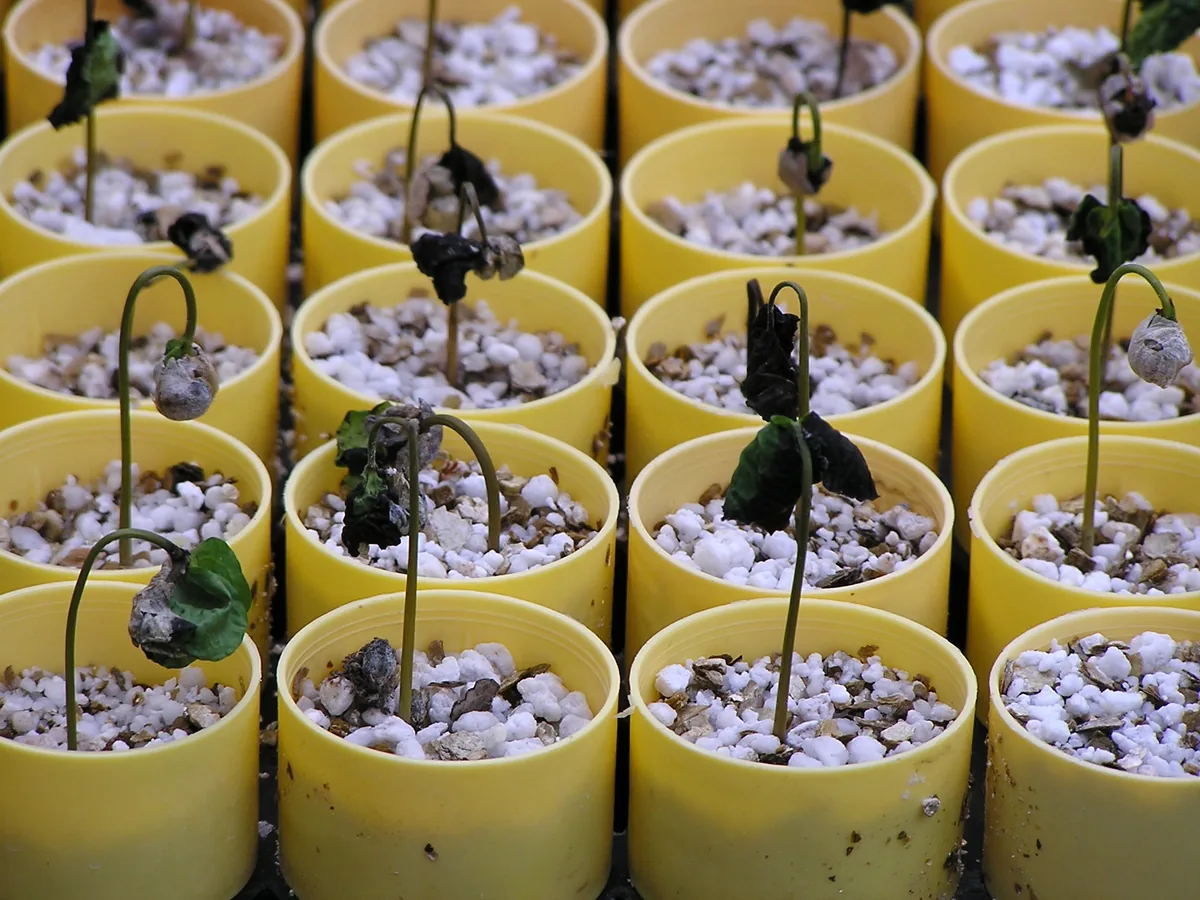
A seedling killer caused by several different fungi working together. It hits vegetables, flowers, herbs, microgreens, and cover-crop seedlings the same way — seeds rot before they emerge, or young seedlings collapse right at the soil line. Wet seed-starting mix and poor airflow in seedling trays are the classic conditions.
Triggers: Wet soil or starting mix, poor drainage, seedlings packed too tightly, contaminated trays or media, and stagnant air all favor damping-off.
Risk fades when: Drying the soil surface and improving airflow slows new spread. Collapsed seedlings don't recover, but the rest of the tray can be saved.
Damping off of coffee seedlings caused by Fusarium sp. — Photo:
Scot Nelson
·
CC0 1.0
Common leaf spot (clover & alfalfa)Pseudopeziza medicaginis, Pseudopeziza trifolii
Moderate
Disease
May–SepPeak window months: May, Jun, Jul, Aug, Sep.
The most common leaf disease of alfalfa and clover cover crops. It makes small, dark brown to black circular spots with slightly fringed edges, often with a tiny raised fruiting disk in the center. Spots start on the lower leaves and move up, and infected leaves yellow and drop, thinning the stand. It is favored by cool, moist weather and is worst in spring and fall.
Triggers: The fungus overwinters in leaf debris and spreads by spores during cool, moist weather. Dry, warm summer weather slows it; cool, moist fall conditions favor a resurgence. A dense canopy that traps humidity raises risk.
Risk fades when: Dry, warm weather slows it. Two days above 82°F or three dry days exits the active window; spotted leaves stay damaged.
Poor establishmentMississippi State Extension states the case in one line: plant establishment is the most critical aspect in any planting.
Moderate
Physiological
Mar, Apr, May, Aug, Sep, OctPeak window months: Mar, Apr, May, Aug, Sep, Oct.
Mississippi State Extension states the case in one line: plant establishment is the most critical aspect in any planting. A cover crop that comes up thin never catches up, and every benefit you sowed it for - nitrogen, biomass, erosion control, weed suppression - scales with the stand you got. Almost all of it is decided in the first week. Seed must reach mineral soil and stay in contact with it. Iowa State is emphatic that seedbed firmness is very important, recommending a cultipacker or roller on tilled seedbeds before planting, then broadcasting onto that firm bed and rolling again for shallow coverage. Depth matters as much as contact: small seed buried too deep never emerges, and Iowa State caps forage seeding depth at half an inch. Broadcast seed sitting loose on a dry surface simply desiccates, which is why MSU says to raise broadcast seeding rates by 25 to 50 percent over drilled rates to compensate for poor seed-to-soil contact and uneven distribution. Then there is temperature. Warm-season species and mixes sown into cool soil sit and rot rather than germinate. And weeds: a crop that emerges into competition thins before it ever closes canopy.
Triggers: Mississippi State Extension: plant establishment is the most critical aspect in any planting; poor seed quality results in uneven stands, stunted growth and limited benefits, so use seed with a recent test date, high germination and pure-seed percentages, and few weed seeds. Increase broadcast seeding rates by 25 to 50 percent over drilled rates to compensate for poor seed-to-soil contact and poor uniformity of distribution; a cultipacker is recommended when broadcast seeding. Broadcasting is not recommended when planting multiple species, because different species require different seeding depths - this is the characteristic failure of a mixed-species stand. Legumes require the correct rhizobium inoculant to fix nitrogen, and inoculant plus fungicide treatment can account for a large fraction of bag weight, reducing actual pure live seed. Iowa State Extension: seedbed firmness is very important; use a cultipacker or roller on tilled seedbeds before planting, broadcast onto a firm tilled seedbed and cultipack or roll for shallow seed coverage and seed-to-soil contact; control seeding depth to no deeper than half an inch; control weeds before planting, since weeds compete with young seedlings for moisture and light. NC State Extension: drill seeding is often the most consistent method, providing improved uniformity and seed-to-soil contact; planting by the recommended dates is crucial for proper establishment, stand and biomass. NRCS defines a weed-free seedbed as not exceeding one weed seedling per square foot at planting. Warm-season species and mixes will not germinate or thrive in cold soil.
On Alfalfa: Slow canopy closure on weak seedings
Prevention: Prepare a clean firm seedbed and seed shallow at adequate density
Risk fades when: A thin stand does not thicken. Once emergence is over, the options are to overseed into the gaps or to accept reduced benefit and terminate on schedule. Fix it at sowing instead. Firm the seedbed before you sow - roll or cultipack a tilled bed. Sow shallow, no deeper than half an inch for small seed, and press or roll the seed in afterward so it contacts mineral soil rather than sitting in loose dust or on top of residue. If broadcasting rather than drilling, raise the seeding rate by 25 to 50 percent. Wait for the right soil temperature: warm-season species and warm-season mixes sown into cool soil will not germinate. Sow into moisture, or irrigate after sowing. Control weeds before planting, not after. Inoculate legume seed with the correct rhizobium. And do not broadcast a multi-species mix if you can drill it, because the species need different depths and one of them will always be wrong.
A rust of alfalfa and clover cover crops that makes small reddish-brown pustules on both leaf surfaces and sometimes on stems. The pustules rupture and release powdery spores, and heavy infection yellows and drops leaves, weakening the stand. It is favored by humid weather and extended leaf wetness.
Triggers: Favored by humidity and extended leaf wetness. Reddish-brown pustules on both leaf surfaces release powdery spores spread by wind. Often associated with nearby spurge as an alternate host.
Risk fades when: Hot or dry weather slows rust. Two days above 88°F or three dry days exits the active window; existing pustules remain.
Feeding & picking
Nutrition & Harvest
How hungry the plant is, what ripe harvest looks like, and how long the crop keeps after picking.
Feeding
Nutrition
Feeding intensityLight feeder
RecipesWorm Castings Topdress, Compost Tea
Timing
Harvest
Terminate at late bud to early bloom or take a first cut once the stand is vigorous and well rooted.
Expected yield0.1–0.25 lbs/plant
Storage Use immediately as mulch, compost feedstock, or green manure.
Plant relationships
Companion Planting
Helpful neighbors can support growth or deter pests. Keep antagonistic plants separated to reduce stress and competition.
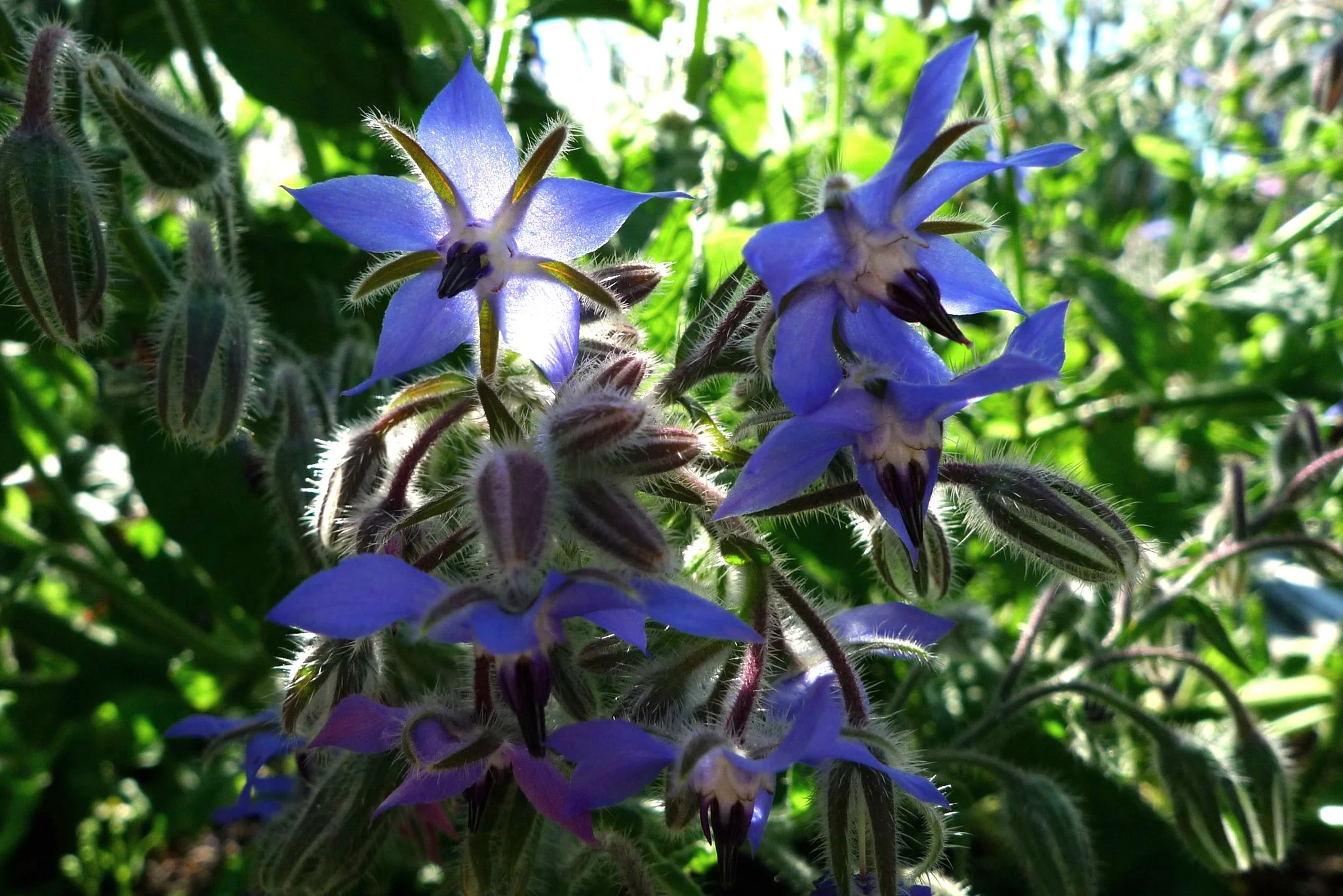
Produces abundant nectar over a long bloom period and attracts honeybees, bumblebees, and native bees.
UMN strawberry pollination study, confirmed increased pollinator visits near borage
Beneficial insectsResearch supported
Attracts parasitic braconid wasps (natural enemy of tomato hornworm), nabid bugs, hoverflies. Host plant for lacewings.
Journal of Apicultural Science 2020
Pest deterrent
Can help against hornworms and cabbage worms indirectly. The flowers draw in small wasps that lay eggs inside the caterpillars and kill them. This only works where those wasps already live, so it is not guaranteed in every garden.
The widely repeated claim that borage scent repels tomato hornworms has no controlled study behind it. What is supported is parasitoid recruitment, which is a different mechanism and is covered by this plant's beneficial-insect-habitat function. Direct repellence would require close planting; predator recruitment works at garden scale.
Soil buildingExtension recommended
Leaves are high in potassium and calcium and break down fast, which makes them good compost material or chopped mulch around other plants.
The claim that borage's deep roots pull nutrients up from the subsoil was removed. That idea, called dynamic accumulation, traces to a single page in a 1986 book and has no research behind it. A Cornell field trial found that what a plant holds simply tracks what is already in the soil around it. The compost and mulch value is real and is what remains.
University of California ANR, garden myths review (dynamic accumulators)
Roots release alpha-terthienyl and related compounds that can suppress root-knot nematodes (microscopic soil worms) when marigolds are grown densely enough for active root/nematode interaction.
Most effective as a dense cover-crop-style stand for a full season before rotating to vegetables. Casual interplanting should not be presented as nematode control.
Can pull aphids, whiteflies and thrips onto itself so they leave your crop alone. Widely done by gardeners, but not tested the way nasturtium has been.
Graded research-supported previously. No controlled trial was located for calendula trap cropping specifically; the practice rests on grower reports. Nasturtium is the better-evidenced trap crop for aphids.
Intercropping with white cabbage significantly reduced diamondback moth larvae and pupae compared with a cabbage monoculture, and calendula was the most effective intercrop tested.
Documented for brassicas in a three-year intercropping trial. This is not evidence of general pest control on other crops, and calendula should not be presented as a nematode treatment.
Jankowska 2010, Vegetable Crops Research Bulletin
Pest deterrent
Sometimes said to keep asparagus beetles and tomato hornworms away by scent. Treat this as traditional garden advice rather than reliable pest control.
No controlled evidence was found for direct repellence by calendula. Its supported contribution is drawing predatory and parasitoid insects, which is covered by its beneficial-insect-habitat function.
Adds 50 to 125 lbs of nitrogen per acre, with the most nitrogen if you let it reach late bloom or early seed set. Cutting it down 30 days earlier than that costs you up to 50 lbs per acre.
Clark 2007, Managing Cover Crops Profitably, 3rd ed. (SARE)
Frost warnings, zone-specific timing, and seasonal nudges -- sent only when there's something to act on. Free, unsubscribe anytime.
Get Personalized Planting Reminders
Frost alerts, zone-specific tips, and seasonal guidance. Free, unsubscribe anytime.
What you'll need
Growing Supplies
Hand-picked for your Alfalfa, with the extension research behind every recommendation.
Mulch / landscape fabric
Nearly every garden benefits from mulch for weed suppression, moisture conservation, and soil temperature moderation. For most home gardeners, quality organic mulch is the better buy over landscape fabric.
Source: Penn State Extension; Wisconsin Horticulture; Illinois Extension
Every gardener benefits from putting water at the root zone instead of on the leaves, because drip and soaker systems reduce foliar disease pressure by limiting leaf wetness and soil splash. A quality kit should include a backflow preventer, filter, pressure reducer, and UV-resistant tubing.
Source: Iowa State University Extension; Colorado State University Extension; UMass Extension
Row cover adds frost protection, speeds early growth, and physically excludes insect pests without spraying. Look for spun-bonded fabric with a stated weight and frost rating, UV resistance, and enough width for hoops or low tunnels.
Source: University of Maryland Extension; University of New Hampshire Extension; Colorado State University Extension
K-State Research and Extension and University of Maryland Extension recommend shade cloth as a heat-management tool for vegetable gardens, with 30 percent shade rating most effective for tomatoes, peppers, and fruiting crops, and 40 to 50 percent for protecting heat-sensitive greens during hot summer months. University of Delaware research found 30 percent black shade cloth tripled marketable yield for bell peppers compared to unshaded plants, and Purdue trials showed shade cloth reduced maximum daily temperatures by 8 to 10 degrees Fahrenheit. Choose knitted polyethylene with reinforced grommets every 18 to 24 inches, mount on hoops or a frame with open sides for airflow, and remove or vent during prolonged wet weather to avoid increased humidity in the canopy.
Source: K-State Research and Extension; University of Maryland Extension; University of Delaware Cooperative Extension; Purdue University Extension
Reflective plastic mulch (white-on-black or silver)
North Carolina State Extension reports that white-on-black plastic mulch can reduce soil temperature by 5 to 20 degrees Fahrenheit and silver mulch by about 6 degrees, the opposite effect of black mulch which warms soil. This makes reflective mulch the appropriate plasticulture choice for hot zones (especially Zone 9a desert and other high-heat low-humidity areas) where overheating limits warm-season crop performance more than cold soil. Silver mulch adds documented aphid and thrips repellency from the reflective surface. Use only with drip irrigation installed underneath, never use plastic mulch without irrigation, and reserve for late spring or early fall plantings where the surrounding heat is the primary stress.
Source: North Carolina State Extension; University of Arizona Cooperative Extension
A soil test gives a baseline for pH and nutrient status so gardeners can add only what the soil actually needs. Prioritize a mail-in or lab-affiliated kit whenever possible because extension guidance notes that laboratory testing is more accurate than instant readers.
Source: University of Maryland Extension; Purdue Extension; Montana State University Extension
University of Minnesota Extension recommends measuring soil temperature 2 to 4 inches below the surface to decide when warm-season crops can actually be planted, because air temperature and average frost dates do not reliably predict whether soil is warm enough for germination. A dedicated soil thermometer with a 4 to 6 inch stainless steel probe gives gardeners a deterministic reading instead of relying on the calendar alone, which matters most in zones with wide last-frost variability. Look for a waterproof stainless steel stem, a clearly marked vegetable-garden temperature range, and a readable analog or digital display at planting depth.
University of Arizona Cooperative Extension notes that most vegetables root in the top 12 to 24 inches of soil and that hot, dry periods require more frequent irrigation, but watering by habit often wets only the top inch while leaving the root zone dry. A dedicated soil moisture meter with a long probe gives gardeners a deterministic reading at root depth instead of guessing from surface appearance, which is most critical in low-rainfall desert zones (Zone 9a Phoenix) and in raised beds or containers that dry from the top down. Look for a single-purpose moisture meter (not a 3-in-1 or 4-in-1 combo, which trade accuracy for feature count) with a probe that reaches 8 to 12 inches and a clear analog or digital display.
Source: University of Arizona Cooperative Extension
UF/IFAS Extension and Texas A&M AgriLife Extension recommend securing or removing trellises, shade cloth, hoop covers, container plants, and lightweight raised-bed accessories before tropical storms and hurricanes, since loose garden items become projectiles in high winds. Most-relevant for Gulf Coast Zone 8b (Houston, Mobile, New Orleans), Florida Zone 9b (Miami, Tampa), and any coastal area within the Atlantic and Gulf hurricane corridors. Galvanized steel ground anchors resist rust in humid coastal soils, and screw-in spiral anchors hold significantly better than driven stakes in saturated soil during storm conditions. Use quick-release fasteners on shade cloth and trellises so they can be removed quickly when a storm watch is issued.
Extension guidance favors bypass designs because they make cleaner, closer cuts on living tissue than anvil types. Look for hardened steel blades that can be sharpened, a comfortable grip, and a cutting capacity matched to real home-garden stems.
Source: University of New Hampshire Extension; Iowa State University Extension; Purdue University Extension
Raised beds improve drainage, let gardeners control soil from day one, reduce compaction, and make gardening more accessible. A quality kit should use rot-resistant, food-safe materials and provide enough depth for productive rooting.
Source: Penn State Extension; University of Delaware Cooperative Extension; Illinois Extension
The most useful mix is three categories: a beginner guide, a reference manual for diagnosis and crop-by-crop lookup, and a soil science book. Look for region-aware editions, strong visuals, and evidence-based authorship.
As an Amazon Associate I earn from qualifying purchases. These are Amazon affiliate links -- if you buy through them, SoilStack earns a small commission at no extra cost to you. It's how we keep the app free and the calendar ad-free. We only link products that match what the research says you actually need.
Research
Sources
Reference material and extension guidance used to build this growing guide.